Tag: rates

  • Von der Leyen and Trump strike EU-US trade deal with 15% tariff for the bloc

    The trade deal will introduce a 15% tariff for the vast majority of EU products. But some will benefit from a “zero-for-zero” scheme.

    ADVERTISEMENT

    The European Union and the United States have struck a tentative trade deal to avert a potentially devastating tariff war between two of the world’s largest economies, capping a race against time before a self-imposed deadline of 1 August.
    Under the agreed terms, finalised on Sunday by European Commission President Ursula von der Leyen and US President Donald Trump during a meeting in Scotland, the majority of EU exports bound for the American market will be subject to a 15% tariff.

    The tariff for US exports bound for the EU market was not immediately clear.
    The deal is preliminary and needs to be further fleshed out.
    “I think it’s great we made a deal today instead of playing games,” Trump said at the end of the meeting. “I think it’s the biggest deal ever made.”
    “It’s a big deal. It’s a huge deal,” von der Leyen said. “It will bring stability, it will bring predictability. That’s very important for businesses on both sides of the Atlantic.”
    Von der Leyen noted the 15% tariff would be “across-the-board” and “all-inclusive”, blocking the application of other duties.

    “It was tough negotiations (but) we came to a good conclusion,” she said, highlighting the “openness” of the EU market, which Trump had vehemently challenged.
    Both leaders shook hands to applause in the room.
    “We were able to make a deal that’s satisfactory to both sides, so it’s a very powerful deal. It’s the biggest of all the deals,” Trump said.
    The 15% rate is lower than the 20% rate that Trump imposed, and later paused, in April as part of his contentious, self-styled “reciprocal tariffs”, as well as the 30% rate that he threatened to slap in a letter sent to von der Leyen earlier this month.

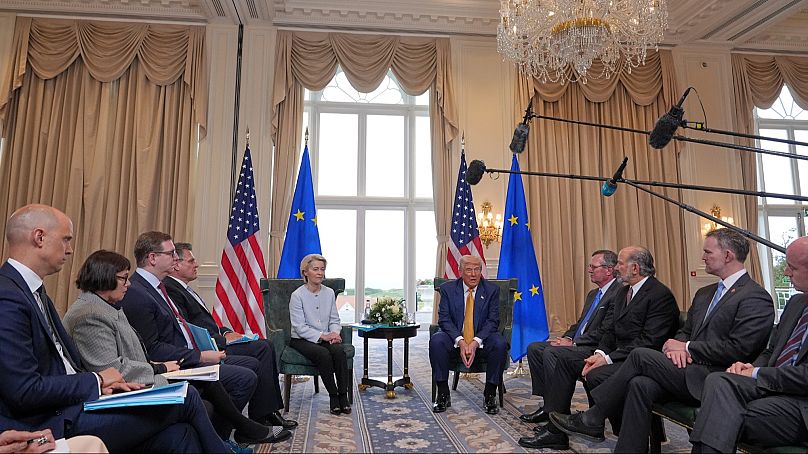
    The 15% rate is also inferior to the rates that other countries have negotiated with the White House in recent days, including Indonesia (19%) and the Philippines (19%), and matches the number granted to Japan (15%), a G7 ally.The von der Leyen-Trump meeting took place in Scotland.The von der Leyen-Trump meeting took place in Scotland.
    AP Photo

    Still, it represents a painful concession, considering the talks began with von der Leyen offering a “zero-for-zero” tariff agreement. Through the back-and-forth process, von der Leyen repeatedly warned that “all options”, including a never-used instrument against economic coercion, were on the table in case of an undesirable scenario.
    As tensions mounted, the European Commission prepared several lists of retaliatory measures against US products worth €93 billion in total.
    Brussels never resorted to any tit-for-tat measure due to stark differences between member states. Some countries, like France and Spain, advocated a show of force against Washington, while others, like Germany and Italy, pushed for a quick deal.
    The ideological gap closed after Trump made his out-of-the-blue 30% threat, which prompted outrage across the bloc and hardened the mood towards retaliation.

    The end of the story?

    Before Trump’s arrival disrupted transatlantic commerce, EU-made products were subject to an average tariff rate of 4.8% upon entering US territory. Sunday’s deal presumably entails an additional 10% to reach the 15% mark.
    EU cars, which are today under a 27.5% tariff, will be brought under the 15% rate.
    A “zero-for-zero” scheme will apply to aircraft and related components, semiconductor equipment, critical raw materials and some chemical and agricultural products.
    “We will keep working to add more products to this list,” von der Leyen said.
    Additionally, she explained, the bloc commits to spending over $250 billion per year on purchasing American liquefied natural gas (LNG), oil and nuclear fuels to replace Russian energy. The total pledge will amount to about $700 billion by the end of Trump’s term.
    Asked about what concessions, if any, the US had made in the talks, the Commission chief replied with a general remark about shared prosperity.
    “The starting point was an imbalance, a surplus (of goods) on our side and a deficit on the US side. We wanted to rebalance the trade relation, and we wanted to do it in a way that trade goes on between the two of us across the Atlantic,” she said.
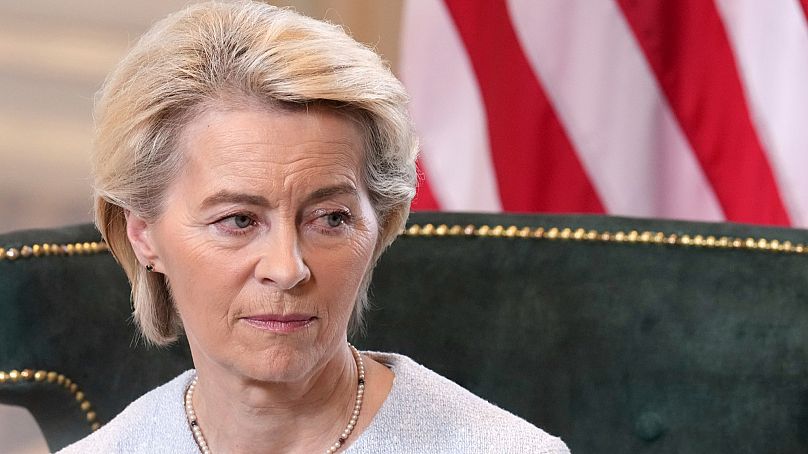
    “I think it’s going to be great for both parties,” Trump said.Von der Leyen said the deal will create "good jobs" for both sides.Von der Leyen said the deal will create “good jobs” for both sides.
    AP Photo

    Sunday’s meeting in Scotland took place amid sky-high expectations due to the looming deadline of 1 August that Trump had imposed to force nations to either offer far-reaching concessions or face punishing tariffs.
    Von der Leyen was accompanied by Maroš Šefčovič, the European Commissioner for Trade, who has been travelling across the two sides of the Atlantic Ocean in an attempt to gain a better understanding of the White House’s maximalist demands.
    She was also joined by her powerful chef de cabinet, Björn Seibert; her trade advisor, Tomas Baert, and the Commission’s director general for trade, Sabine Weyand.
    In the last stretch of negotiations, von der Leyen’s team had realised that 15% was the lowest number that Trump was willing to settle for. The 15% rate was considered high for the bloc but palatable if paired with carve-outs for strategic sectors.
    A major concern along the way has been pharmaceuticals, which the EU exports in large volumes to the American market. The White House has opened a formal investigation into pharma products, a step that can pave the way for a tailor-made tariff.
    At the start of the meeting, Trump said pharma would be excluded from the deal.
    “We have to have them built and made in the United States, and we want them made in the United States,” Trump told reporters. “Pharmaceuticals are very special. We can’t be in a position where (…) we’re relying on other countries.”
    At the end of the meeting, von der Leyen said EU-made drugs would fall under the 15% rate but admitted Trump could take further action to address the matter “globally”.
    “15% is certainly a challenge for some, but we should not forget that it keeps us access to the American market,” she admitted, noting the bloc would continue to diversify its trade partners to create greater opportunities for European exporters and investors.
    The saga might soon take another twist: next week, a federal appeals court in the US will begin hearing arguments in a closely-watched lawsuit challenging Trump’s authority to slap across-the-board tariffs under the pretext of a national emergency.
    This article has been updated with more information.
  • 'Forever chemicals’ found in reusable period products. What do we know about their health impact?

    'Forever chemicals’ found in reusable period products. What do we know about their health impact?

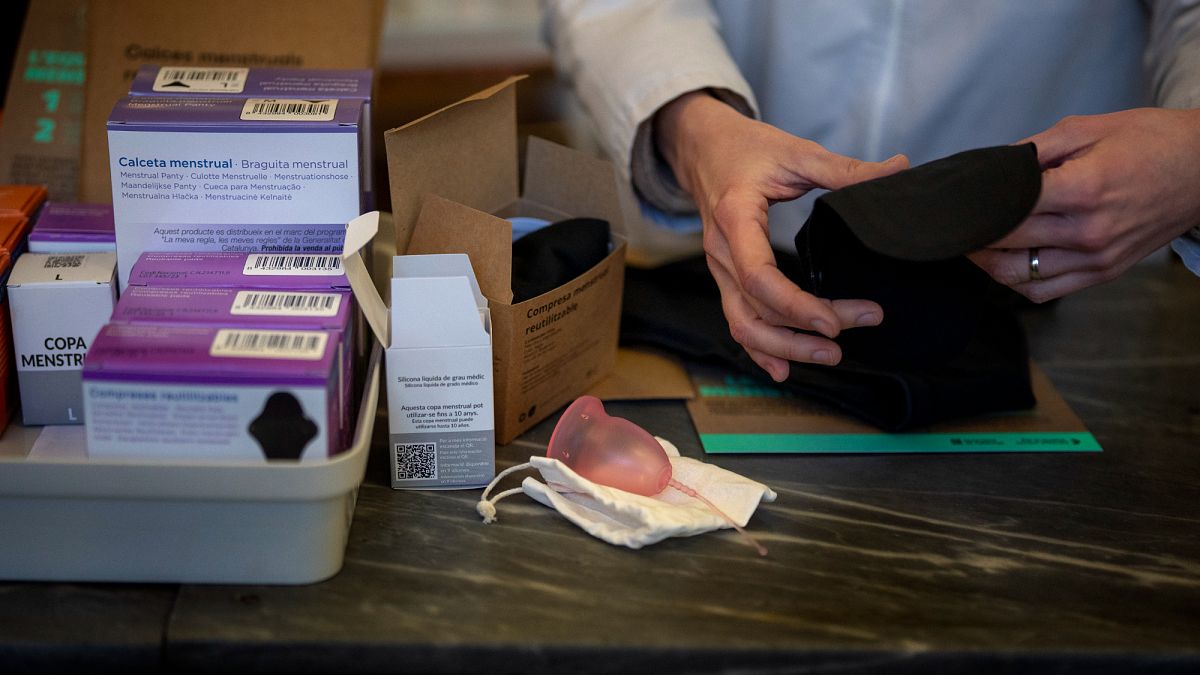
    Underwear and reusable pads show the highest levels of a marker indicating intentionally added PFAS, raising concerns about the safety of menstrual products, according to new research.

    ADVERTISEMENT

    Reusable women’s hygiene products can contain toxic chemicals, according to a study published last week that tested items from North America, South America, and Europe. 
    Published in Environmental Science and Technology Letters, the peer-reviewed article specifically found evidence of per- and polyfluoroalkyl (PFAS) substances in eco-friendly menstrual and incontinence products, reviving the debate about the safety and health effects of feminine hygiene items.

    PFAS, also known as “forever chemicals,” consist of a large group of man-made substances with exceptional resistance to degradation. For more than 70 years, they have been added to various consumer products, among others, to enhance resistance to water, grease, and stains.

    Related

    Forever chemicals: What are they and could they be totally banned in the EU?

    The research team tested 59 products from five categories: period underwear, reusable pads, reusable incontinence underwear, reusable incontinence pads, and menstrual cups.
    To assess PFAS presence, scientists measured the total fluorine content, a chemical element whose elevated levels typically suggest the likely presence of ‘forever chemicals’. They then extracted a smaller subset of 19 products and conducted a more in-depth analysis, targeting the levels of specific PFAS. 
    PFAS were detected in 100 per cent of the smaller sample of 19 products.  Evidence of intentionally added PFAS was found in nearly 30 per cent of the full group of 59 products, with period underwear and reusable pads showing the highest rates. 

    Marta Venier, one of the study’s authors and an environmental chemist at Indiana University, explained that the distinction between intentional and unintentional PFAS presence depends on the amount of total fluorine detected.
    “When levels were above a certain threshold, that indicates that PFAS were added to the product intentionally to impart properties such as waterproofing, for example,” she told Euronews Health.
    In contrast, lower levels likely point to unintentional contamination during the manufacturing process, she added.

    In each category of products, we found items that did not have intentionally added PFAS. This shows that you can still make these products without adding PFAS.

    Marta Venier

    One of the study’s authors and an environmental chemist at Indiana University

    This distinction is particularly significant. “In each category of products, we found items that did not have intentionally added PFAS. This shows that you can still make these products without adding PFAS,” Venier pointed out.
    “This tells us they [PFAS] are not a necessary addition to make the products functional,” she continued.

    What are the health risks of PFAS on women’s health?

    PFAS include more than 10,000 substances; as a result, research has not fully determined the specific health effects of each one. 
    Despite this gap, there is strong scientific evidence linking PFAS exposure to adverse health outcomes. 
    In 2023, the World Health Organization (WHO) classified two PFAS as carcinogenic and possibly carcinogenic to humans. These included perfluorooctanoic acid (PFOA) and perfluorooctanesulfonic acid (PFOS), both banned in the European Union. 
    In addition to the risk of tumours, PFAS can damage the immune system of newborns due to maternal exposure to these toxic chemicals, which tend to accumulate in bodies over time, Tina Kold Jensen, a physician and environmental epidemiologist at the University of Southern Denmark, told Euronews Health.
    “You are exposed to these substances through hygiene products, then it will take at least four years before half of what you’re exposed to is out of the body. And since it’s there, women of reproductive age pass them on to their children through the placenta and breast milk,” she said.

    Related

    Exposure to ‘forever chemicals’ linked to gut health and kidney damage in young adults, study finds‘Forever chemicals’ exposure before birth raises the risk of high blood pressure in teenage years

    Jensen also noted that PFAS exposure has been associated with other health issues, including high cholesterol, altered liver enzymes, kidney cancer, and reproductive problems. However, she emphasised that not all of these effects are fully confirmed and said that further research is needed. 
    Another uncertainty concerns whether the direct contact of pads with the skin poses greater, lesser, or equal health risks compared to environmental exposure to ‘forever chemicals’. 
    “PFAS exposure is mostly through the gastrointestinal channel. (…) Skin is quite a good barrier, but we don’t know much. But here we’re talking not only about the skin but also the vagina, its lips, that’s different,” Kold Jensen said.
    Regarding reusable pads, Jensen added that environmental exposure is another concern: “There’s a lot of PFAS in the environment, and they will definitely get into the environment once you wash the pads,” she said. 
    To sum up, there are still more questions than answers when it comes to the effects of PFAS on women’s health. But do these eco-friendly pads pose other health risks?

    What do we know about reusable menstrual products?

    Sustainable period products are becoming increasingly common among young people. 
    According to a 2022 study, in Spain, the use of reusable hygiene products surpassed that of disposable ones among people aged 26 to 35 at the time of the survey. 
    The Catalan government launched a public health initiative offering a free menstrual cup, one pair of underwear and two packages of cloth pads to reduce both period poverty and the waste generated by disposable products last March.
    Reusable products, in fact, have been shown to be more sustainable alternatives to single-use items. Specifically, menstrual cups appear to have the lowest environmental impact, followed by period underwear and reusable pads. 
    Aside from recent concerns about PFAS, reusable menstrual products have not been shown to pose any other major health threat, according to a global review on reusable menstrual pads. The only relevant concern appears to be skin irritation associated with long-term use of these products or inadequate cleaning or drying of the items. 
    A similar study conducted on menstrual cups found that these products are generally safe, except for rare cases of vaginal injuries, toxic shock syndrome, or urinary problems.  
    As for period underwear, major concerns are related to PFAS and other elements. An investigation conducted by the UK-based organisation Which? in 2023 found high silver levels in some popular period pants brands like Intima, M&S and Thinx. This May 2, 2016, photo shows Thinx that are reusable “period-proof” underwear in New York.This May 2, 2016, photo shows Thinx that are reusable “period-proof” underwear in New York.
    Bonny Ghosh/AP

    Thinx, in particular, has also been at the centre of the PFAS debate, when in 2020 Sierra Magazine published an investigation with the University of Notre Dame, finding PFAS in the period underwear of the brand. This led to one class-action case against the company, which was settled at the end of 2022. 

    Related

    Toxic chemicals found above safe levels in 10% of women’s underwear in lab tests

    PFAS, however, are not exclusively present in reusable products, but they have also been found in disposable ones. In 2022, lab tests commissioned by the US consumer watchdog Mamavation and Environmental Health News revealed that PFAS were present in 48% of 46 tested sanitary pads, underwear liners, and incontinence pads. 
    Another common factor for both single-use and reusable menstrual products is the need for further research to assess the types of PFAS present, their levels, and their health effects.

  • Unexpected: Ireland Now Outpaces All Countries in Education

    Unexpected: Ireland Now Outpaces All Countries in Education

    Education: The Secret Sauce Behind National Wealth

    Picture a country’s prosperity as a big pot of soup. One of the most essential ingredients is the education level of its working-age population. When the workforce is well‑educated, it’s like adding premium spices: productivity goes through the roof, innovation sparkles, and the economy gets that extra oomph it needs.

    Why an Educated Workforce Rocks

    • Higher productivity – Skilled workers finish tasks faster and more efficiently.
    • Innovation on tap – Fresh ideas keep the economy buzzing with new products and services.
    • Economic growth engine – A knowledgeable labor force is the backbone of a dynamic, competitive economy.

    The Global Leaderboard: Data from Visual Capitalist & CBRE Research

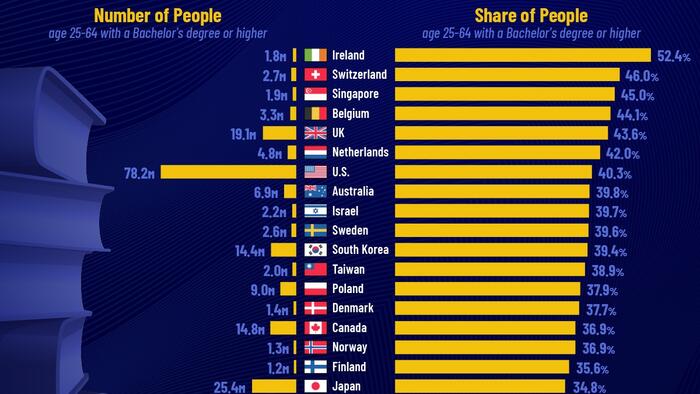
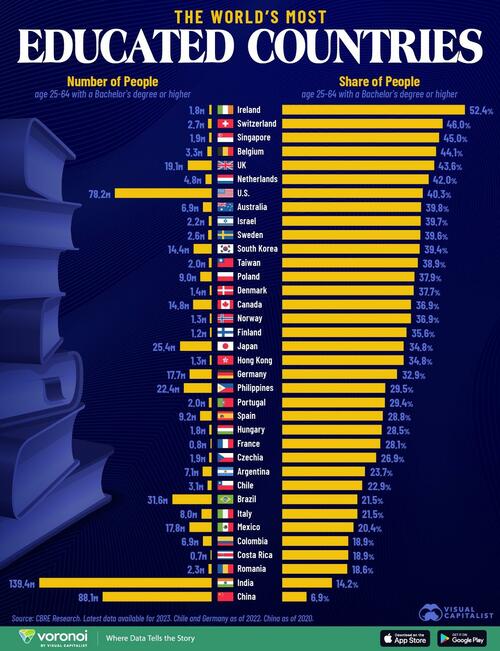
    Check out the chart that Visual Capitalist’s Niccolo Conte produced. It ranks countries based on two key metrics:

    • Number of adults aged 25–64 with a bachelor’s degree or higher
    • Share of that adult cohort holding a bachelor’s degree or higher

    The data pulls the latest figures available as of 2023, giving a clear snapshot of which nations boast the most educated workforces.

    Which Countries Have the Most Educated Populations?

    Who’s Got the Brainwave Badge?

    Across the globe, the race for higher‑education bragging rights is in full swing. Developed countries are practically leaning on the sidelines, flaunting impressive enrolment numbers, while emergent economies are grinding their way up the ladder.

    Top 20 – Populated with Degrees

    • Ireland – 1.8 M, 52.4 % of adults aged 25–64 have a bachelor’s or better.
    • Switzerland – 2.7 M, 46.0 %.
    • Singapore – 1.9 M, 45.0 %.
    • Belgium – 3.3 M, 44.1 %.
    • UK – 19.1 M, 43.6 %.
    • Netherlands – 4.8 M, 42.0 %.
    • USA – 78.2 M, 40.3 %.
    • Australia – 6.9 M, 39.8 %.
    • Israel – 2.2 M, 39.7 %.
    • Sweden – 2.6 M, 39.6 %.
    • South Korea – 14.4 M, 39.4 %.
    • Taiwan – 2.0 M, 38.9 %.
    • Poland – 9.0 M, 37.9 %.
    • Denmark – 1.4 M, 37.7 %.
    • Canada – 14.8 M, 36.9 %.
    • Norway – 1.3 M, 36.9 %.
    • Finland – 1.2 M, 35.6 %.
    • Japan – 25.4 M, 34.8 %.
    • Hong Kong SAR – 1.3 M, 34.8 %.

    West’s Academic Powerhouse

    Europe sits on top of the list, claiming six of the first ten spots. “Learn, earn, repeat” has become the mantra for this continent, especially in Ireland – a crowd‑pleaser with 52 % of its working‑age population holding a degree or higher.

    Big‑Name, Big Numbers

    While India and China have the lowest shares, they still dominate in sheer volume because of their gigantic populations. The U.S. punches above its weight, having the third‑largest cohort of education holders and a robust 40 % share.

    South American Reality Check

    Chilean, Brazilian, Colombian, and Costa Rican scholars climb the rankings, but their achievement rates hover between 19 % and 23 %. A tough climb but not impossible!

    Why It All Matters
    • GDP > Education – There’s a clear, friendly link between a nation’s wealth and how many of its citizens hold degrees.
    • Developing the Workforce – Access to higher education is a lifeline for countries where a lot of the workforce still has fewer than a high school diploma.

    So if you’re looking to boost your personal bank account or a nation’s economy, just pick a good university, grab a degree, and join the rank!