Category: technology

  • Nvidia Is Developing New AI Chip For China That Outperforms H20

    Nvidia Is Developing New AI Chip For China That Outperforms H20

    Having recently agreed on a China “revenue-share” deal with the Trump admin, the world’s leader in chatbot chip production, Nvidia, is developing a new AI chip especially for China based on its latest Blackwell architecture that will be more powerful than the H20 model it is currently allowed to sell there, Reuters reported citing sources. 

    The new chip, tentatively known as the B30A, will use a single-die design that is likely to deliver half the raw computing power of the more sophisticated dual-die configuration in Nvidia’s flagship B300 accelerator card, the sources said.
    A single-die design is when all the main parts of an integrated circuit are made on one continuous piece of silicon rather than split across multiple dies.

    The new chip would have high-bandwidth memory and Nvidia’s NVLink technology for fast data transmission between processors, features that are also in the H20 – a chip based on the company’s older Hopper architecture. While the chip’s specifications are not completely finalized Nvidia hopes to deliver samples to Chinese clients for testing as early as next month.

    Last week Trump opened the door to the possibility of more advanced Nvidia chips being sold in China. But the sources noted U.S. regulatory approval is far from guaranteed amid deep-seated fears in Washington about giving China too much access to U.S. artificial intelligence technology.

    When reached by Reuters, Nvidia said in a statement: “We evaluate a variety of products for our roadmap, so that we can be prepared to compete to the extent that governments allow.”

    “Everything we offer is with the full approval of the applicable authorities and designed solely for beneficial commercial use,” it said.

    The extent to which China, which generated 13% of Nvidia’s revenue in the past financial year, can have access to cutting-edge AI chips is one of the biggest flashpoints in U.S.-Sino trade tensions. Nvidia only received permission in July to recommence sales of the H20. It was developed specifically for China after export restrictions were put in place in 2023, but company was abruptly ordered to stop sales in April.

    Last week Trump said he might allow Nvidia to sell a scaled-down version of its next-generation chip in China after announcing an unprecedented deal that will see Nvidia and rival give the U.S. government 15% of revenue from sales of some advanced chips in China.

    A new Nvidia chip for China might have “30% to 50% off”, he suggested in an apparent reference to the chip’s computing power, adding that the H20 was “obsolete”.

    US legislators have worried that access to even scaled-down versions of flagship AI chips will impede U.S. efforts to maintain its lead in artificial intelligence. But Nvidia and others argue that it is important to retain Chinese interest in its chips – which work with Nvidia’s software tools – so that developers do not completely switch over to offerings from rivals like Huawei.

    Huawei has made great strides in chip development, with its latest models said to be on par with Nvidia in some aspects like computing power, though analysts say it lags in key areas such as software ecosystem support and memory bandwidth capabilities. That said, last week China’s AI leader DeepSeek was forced to revert to Nvidia for its R2 model after Huawei’s AI chip failed. As the FT reported, after the successful launch of its R1 model in January, DeepSeek found itself under pressure from China to champion the national cause. The message was clear: use Huawei’s chips, not Nvidia’s. But when it came to actually training their new R2 model, DeepSeek ran into “persistent technical issues” with Huawei’s AI chips. The problems were so fundamental that the project ground to a halt. A person with knowledge of the situation said this was the main reason the model’s planned launch in May was scrapped, putting the company on the back foot in a market that waits for no-one.

    Complicating Nvidia’s efforts to retain market share in China, Chinese state media have also in recent weeks alleged that the U.S firm’s chips could pose security risks, and authorities have cautioned Chinese tech firms about purchasing the H20. Nvidia says its chips carry no backdoor risks.

    Nvidia is also preparing to start delivering a separate new China-specific chip based on its Blackwell architecture and designed primarily for AI inference tasks, according to two other people familiar with those plans. Reuters reported in May that this chip, currently dubbed the RTX6000D, will sell for less than the H20, reflecting weaker specifications and simpler manufacturing requirements.

    The chip is designed to fall under thresholds set by the U.S. government. It uses conventional GDDR memory and features memory bandwidth of 1,398 gigabytes per second, just below the 1.4 terabyte threshold established by restrictions introduced in April that led to the initial H20 ban.  Nvidia is set to deliver small batches of RTX6000D to Chinese clients in September. 

    Loading recommendations…
  • Video Games At 30,000 Feet? Starlink's Airline Rollout Is Making It Reality

    Video Games At 30,000 Feet? Starlink's Airline Rollout Is Making It Reality

    In-flight Wi-Fi has long been notorious for being slow, spotty, and expensive. Well, that’s until Elon Musk’s SpaceX Starlink entered the skies three years ago. The low-Earth orbit satellite service has ignited a race among airlines to install high-speed, low-latency terminals, transforming the passenger experience. Now, gaming or even logging into a Bloomberg Terminal mid-flight is possible. 

    Bloomberg reports a rapid adoption of Starlink among airlines, including United Airlines, Air France, Qatar Airways, Virgin Atlantic, and now Alaska Air. Sources say British Airways is also in talks to adopt the service, which delivers up to 200 Mbps download, 8 Mbps to 25 Mbps upload, and latency under 99 ms. This is a far cry from the dial-up speeds still common on most commercial jets.

    According to the media outlet, Starlink’s next target is to be an early mover of high-speed internet for premium Gulf carriers such as Emirates, FlyDubai, Gulf Air, and Saudia. This would be a significant win for the company and game-changing for the massive long-haul fleets. 

    Starlink faces fierce global competition from EchoStar, Viasat, SES, and Intelsat. These rivals are defending market share and revamping strategies to strike new deals as the race over the $100 billion satellite communications market accelerates ahead of the 2030s. 

    The cost to install a Starlink aviation receiver on a Boeing 737 is approximately $300,000, while a 787 Dreamliner model totals around half a million per aircraft, according to documents reviewed by Bloomberg. Airlines pay upwards of $120 per seat monthly for the service, with an additional $120 for live television. 

    What’s important to note is that Starlink is a first-mover in the high-speed in-flight Wi-Fi market that airlines are rapidly adopting. Competition from Amazon’s Project Kuiper is not even a discussion at the moment. 

    At the moment, Starlink remains a division of SpaceX and has not filed for an IPO. No underwriters have been appointed, and there’s no confirmed timetable, despite Musk’s recent comments about a public offering “at some point in the future.” 

    Starlink has introduced a new $5-per-month “Standby Mode,” giving customers unlimited low-speed data for calls, texts, and instant reactivation during emergencies or in dead zones, according to a new company email.

    The feature appears aimed at retaining subscribers who might otherwise cancel month-to-month service and only reactivate when needed. By keeping accounts active, Standby Mode could help stabilize Starlink’s subscriber base. This is likely a move that may carry weight ahead of a potential IPO.

    Loading recommendations…
  • Big Tech Could Soon Use Brain Chips To Read Your Innermost Thoughts: Study

    Big Tech Could Soon Use Brain Chips To Read Your Innermost Thoughts: Study

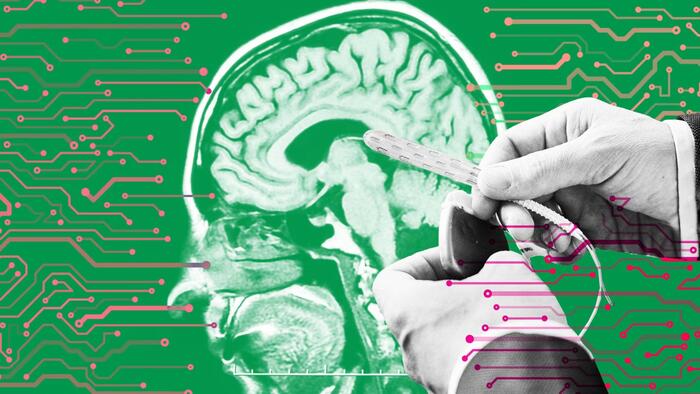
    A new study out of Stanford University reveals that neural implants, also known as brain-computer interfaces (BCIs), might not just help paralyzed individuals communicate – they could potentially lay bare your innermost thoughts to Big Tech.

    Published in the medical journal Cell, the research shows these devices can decode brain signals to produce synthesized speech faster and with less effort.

    BCIs work by using tiny electrode arrays to monitor activity in the brain’s motor cortex, the region controlling speech-related muscles. Until now, the tech relied on signals from paralyzed individuals actively trying to speak. The Stanford team, however, discovered that even imagined speech generates similar, though weaker, signals in the motor cortex. With the help of artificial intelligence, they translated those faint signals into words with up to 74% accuracy from a 125,000-word vocabulary.

    “We’re recording the signals as they’re attempting to speak and translating those neural signals into the words that they’re trying to say,” said Erin Kunz, a postdoctoral researcher at Stanford’s Neural Prosthetics Translational Laboratory.

    But this technological leap has raised red flags among critics who warn of a dystopian future where your private thoughts could be exposed.

    Nita Farahany, a Duke University law and philosophy professor and author of The Battle for Your Brain, sounded the alarm telling NPR, “The more we push this research forward, the more transparent our brains become.”

    Farahany expressed concern that tech giants like Apple, Google, and Meta could exploit BCIs to access consumers’ minds without consent, urging safeguards like passwords to protect thoughts meant to stay private.

    We have to recognize that this new era of brain transparency really is an entirely new frontier for us,” Farahany said.

    While the world fixates on artificial intelligence, some of the tech industry’s heaviest hitters are pouring billions into BCIs. Elon Musk, the world’s richest man, has raised $1.2 billion for his Neuralink venture, which is now conducting clinical trials with top institutions like the Barrow Neurological Institute, The Miami Project to Cure Paralysis, and the Cleveland Clinic Abu Dhabi.

    Now, another tech titan is entering the fray.

    OpenAI co-founder Sam Altman is launching Merge Labs to challenge Musk’s Neuralink. Backed by OpenAI’s venture arm and valued at $850 million, Merge Labs is seeking $250 million in funding, according to the Financial Times. While Altman will serve as a co-founder alongside Alex Blania of the iris-scanning World project, sources say he won’t take an operational role.

    Loading recommendations…
  • Chinese EV Firm Bets Big On Battery-Swapping Over Battery-Charging

    Chinese EV Firm Bets Big On Battery-Swapping Over Battery-Charging

    Challenging electric vehicle orthodoxy, US-listed Chinese EV start-up Nio is leading the charge on a different approach to re-energizing vehicles — having drivers swap out spent batteries rather than recharging them. With swapping stations already up and running in 285 Chinese cities, Nio is betting that consumers will be won over by time savings and cost advantages of battery-swapping. 

    The technology is well beyond the pilot phase: In July, Nio celebrated is 80 millionth battery swap in China. The swap is easier than filling up a petrol car or re-charging a typical EV. After pulling up to a swapping station, the driver issues a command via voice or the car’s input screen. The car then drives itself into the station, stopping above a retractable metal floor. Robotic arms remove the spent battery and insert a new one. After a quick software and hardware check, the driver is back on the streets — with the whole swapping process taking only about 3 minutes.  

    Faster re-powering is one advantage. Battery-swapping can also slash the price of a car by thousands of dollars, because the vehicle owner doesn’t own the battery, notes Financial Times. That also eliminates the potential for a huge expense when a battery is damaged or dies. It also makes sense for people living in densely populated cities, where dedicated charge points may not be plentiful in apartment buildings. 

    China may hit a major EV milestone this year, with EV sales topping internal combustion for the first time. Chinese battery maker CATL — the largest producer in the world — plans to build 1,000 swap stations for passenger vehicles in China in 2025, targeting 10,000 stations by 2028 with a capacity for 1 million battery swaps a day. China is offering subsidies that cover up to 40% of the cost of building swapping stations. 

    Nio’s top-of-the-line EP9 will cost you more than a million dollars. It owns the fastest EV lap time at Nurburgring — 45.9 seconds  (via Nio)

    Nio has established a modest battery-swapping beachhead in Europe, with 60 stations concentrated in Norway and Germany. Nio’s map also shows stations in Sweden, Denmark, Belgium and the Netherlands. Earlier this week, NIO celebrated its 200,000th European battery swap. The company said 74% of European users “now choose the speed and ease of changing batteries.” However, the pace at which the company is installing new swap-stations in Europe has stalled, with just 10 stations opening in the past year. In April, EV reported that Nio had significantly cut its investment in European expansion. Managing battery compatibility — to cover the various batteries used by different EV brands — appears to be one of the challenges in rolling out new European stations.  

    Some in the industry think battery-swapping isn’t the best avenue, with a high cost of infrastructure among the concerns. He Xiaopeng, chief executive of EV maker Xpeng, told the Times that his firm considered that alternative process “for five or six years” before discarding it altogether around 2023. “Advancing battery technology is [more important] than developing battery-swapping capabilities. That’s the path we’ve chosen,” said He. Across the EV industry, the emphasis has been on flash recharging. Last month, China’s National Development and Reform Commission announced it will build 100,000 fast-charging stations over the next two years

    Loading recommendations…
  • These Are The World's Most Powerful Cars

    These Are The World's Most Powerful Cars

    From hybrid hypercars to high-output EVs, the amount of horsepower that today’s cars can generate is truly impressive.

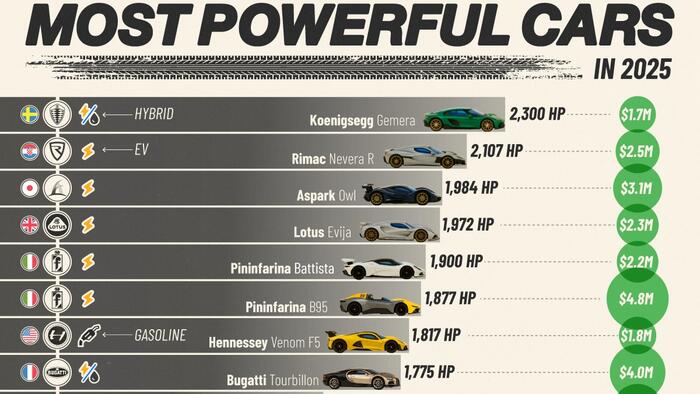
    In this infographic, Visual Capitalist’s Marcus Lu ranks the 20 most powerful cars of 2025, spanning gasoline, hybrid, and fully electric powertrains.

    Data & Discussion

    The data for this ranking comes from Motor1. It details the horsepower, pricing, and origins of the most extreme production vehicles available in 2025.

    While price tags often run into the millions, some surprising entries challenge the notion that power always comes with exclusivity.

    Koenigsegg and Sweden’s Role in Hypercar Engineering

    Koenigsegg remains a standout in this ranking as the only Swedish manufacturer on the list. Its flagship Gemera produces 2,300 hp, not only topping the global leaderboard but also defying convention by being a four-seater hybrid.

    While the standard Gemera pairs a 3-cylinder twin-turbo engine with three electric motors for 1,700 hp, the upgraded 2,300 hp version utilizes a V8 engine and a single electric motor.

    Sweden’s engineering reputation has traditionally leaned toward safety and practicality, but Koenigsegg has carved out a unique niche in the hypercar market. All of its cars are highly exclusive and cost upwards of $1 million.

    Big EV Power from Accessible Brands

    Electric vehicles are present throughout this ranking, with models from Tesla, Rivian, and Lucid appearing alongside million-dollar hypercars.

    The Tesla Model S Plaid and Rivian R1T Quad Motor both cross the 1,000-horsepower threshold while staying somewhat closer to consumer budgets (The R1T Quad is expected to start at $115,990).

    If you enjoyed today’s post, check out America’s Favorite Car Brand by Generation on Voronoi, the new app from Visual Capitalist.

    Loading recommendations…
  • Microsoft Sends 60 Day Warning To Windows 10 Users

    Microsoft Sends 60 Day Warning To Windows 10 Users

    Authored by Melanie Sun via The Epoch Times (emphasis ours),

    As Microsoft moves toward ending its support of Windows 10, PC users who haven’t yet upgraded to Windows 11 now have less than 60 days to take action to make sure their devices are receiving updates for cyber threats.

    Visitors try out Windows 10, the latest operating system from software giant Microsoft, during a launch event in Seoul on July 29, 2015. Jung Yeon-Je /AFP

    On Aug. 16, Windows 10 users may have noticed a message on their devices, warning that they have 60 days left to take action before security and feature updates and technical support for their PC ends on Oct. 14.

    Microsoft announced in 2023 that it was ending support for its Windows 10 platform as it rolled out Windows 11—calling it its “home for AI”and its “most secure version of Windows ever” due to “hardware-based” advanced security features.

    Companies and organizations that operate Windows 10 may find it challenging to maintain regulatory compliance with unsupported software,” Microsoft said in a blog post in June.

    Not all PC users are able to or want to switch to a new operating system that offers new AI functionalities. Some older devices are not compatible with Windows 11, due to the system’s increased processing and hardware requirements. According to market share data, around 700 million PC users, or 43 percent, are still using Windows 10, which was launched in July 2015. Windows 11 holds about 53 percent of the market share.

    The company has faced legal action demanding that it extend free support for Windows 10 users until their market share drops below 10 percent, although it’s yet to be seen if the complaint will succeed in court. Windows 10 has been one of Microsoft’s most popular operating systems.

    Currently, Windows 10 users will have to take action before the Oct. 14 deadline to make sure their devices don’t fall off support after critical security updates end.

    “With Windows 10 support coming to an end in October, we’re here to provide information and resources to help you choose the path that works best for you—whether that’s exploring the next generation of Windows, staying on your current PC with the Extended Security Program (ESU) or moving to a cloud-based solution,” the company said on the transition.

    Although users’ Windows 10 devices will continue to function, “they will no longer receive regular security updates, making them more vulnerable to cyber threats, such as malware and viruses.”

    Microsoft is rolling out enrolment in its transition program, which allows those on the Windows 10 system to continue to receive security support until October 2026.

    The Windows 10 Extended Security Updates (ESU) program is designed to keep your current Windows 10 PC protected after support ends—helping you stay secure during the transition,” the company said.

    The company has also said it plans to continue offering security updates for Microsoft Defender Antivirus through October 2028. Microsoft 365 Apps will also continue to receive security updates until Oct. 10, 2028. However, feature updates for the apps will be discontinued from August next year. Technical support will also not be extended for Windows 10 users.

    “These updates are intended to help ease customers’ transition to Windows 11 and will be delivered through standard update channels. These updates do not include technical support,” Microsoft said.

    To continue receiving support from Microsoft, users have two options: enrol in the ESU program with an annual payment or link their devices to Microsoft’s cloud.

    The first option will cost individual users $30. The payment can be made using a Microsoft account, and will cover as many as 10 devices through to Oct. 13, 2026. Alternatively, accounts can use 1,000 Microsoft Rewards points as payment.

    Users have also been offered a cloud-based solution. In this option, they can choose to sync their Windows 10 device to Microsoft’s cloud service, Windows 365, which will allow them to access Windows 11 Cloud PCs on Microsoft’s servers. Those with a lot of data can sign up for a Windows 365 cloud service plan.

    The link for ESU enrolment can be found on the company’s Windows Update page.

    Loading recommendations…
  • Wild Splashdown Footage Of SpaceX Starship Megarocket

    Wild Splashdown Footage Of SpaceX Starship Megarocket

    After multiple launch attempts this week, most of which were due to adverse weather conditions and ground-based issues, Starship Flight 10’s launch was a wild success, with both the Super Heavy booster and the Starship Upper Stage successfully landing on their designated splashdown zones. 

    Yet the far-left corporate media, controlled by liberal elites whose credibility sinks by the week, just couldn’t give credit where it was due.

    So…

    According to SpaceX, in a statement following Flight 10, “every major objective was met, providing critical data to inform designs of the next generation Starship and Super Heavy.”

    To end the week, SpaceX published some absolutely wild footage of the Starship splashdown in the Indian Ocean. 

    Additional commentary on Starship’s splashdown…

    Looking ahead, Musk wrote on X that test flights 13, 14, and 15 will most likely be when SpaceX uses its massive launch tower – outfitted with “chopstick” arms – to catch Starship, a system already employed to catch the Super Heavy booster.

    Loading recommendations…
  • Goldman's iPhone 17 Breakdown Ahead Of "Awe Dropping" Event

    Goldman's iPhone 17 Breakdown Ahead Of "Awe Dropping" Event

    Apple announced on Tuesday that its upcoming “Awe Dropping” iPhone 17 event will take place on September 9. The launch is expected to feature an all-new super-thin iPhone, new Watch models with satellite connectivity, and the long-awaited AirPods Pro 3.

    Ahead of the launch event, Goldman analysts led by Michael Ng told clients that his desk is “Buy” rated on the stock. 

    “We are encouraged by reports surrounding (1) form factor updates to iPhone 17 models (17 “Air” model, larger base screen size); (2) the potential for a price increase to the iPhone 17 Pro; and (3) continued carrier competition driving device-related promotions,” Ng told clients. 

    He stated, “We reiterate our Buy rating on AAPL and forecast iPhone revenue to grow +5% yoy in F2025E before accelerating to +7% yoy growth in F2026E.”

    Ng expects four new iPhone models to be launched at the beginning of the iPhone 17 cycle:

    1. iPhone 17 (base);

    2. iPhone 17 “Air” (replacing the Plus model);

    3. iPhone 17 Pro; and

    4. iPhone 17 Pro Max.

    So, what’s really changing with the new iPhone? Good question. The analyst provides some thoughts:

    First, the iPhone 17 series will reportedly feature a variety of different form factor changes (Exhibit 1). For one, Apple should debut the first iPhone 17 “Air” model (which should replace the iPhone “Plus” model), featuring a thinner and lighter form factor relative to other iPhone models, with a display size between that of the 17 Pro (6.3″) and 17 Pro Max (6.9″). In addition, the iPhone 17 base model display size should now measure 6.3″ (v. 6.1″ in the base iPhone 16 model), now equal to that of Pro models. Second, the iPhone 17 series should be able to support greater compute intensity, with updated A19 series processor chips and 12 GB of RAM (v. 8GB RAM in the iPhone 16 family). iPhone 17 Pro & Pro Max models should feature premium chip models (likely A19 Pro), and the iPhone 17 (base) and Air models featuring a less advanced chip model (A19 base or less compute intensive A19 Pro). Greater chip power and RAM capacity likely reflects a greater need for compute intensity ahead of upcoming Apple Intelligence feature updates and releases, including the 2026 expected release of AI-enhanced Siri. Third, the iPhone 17 series should see an improved front camera (24 MP v. 12 MP in the iPhone 16 family).

    Thoughts on pricing:

    Though it has been reported that Apple could raise prices by $50 across its iPhone 17 line up, we expect pricing for iPhone 17 (base) and Pro Max models to be in-line with that of preceding models ($799 128GB base model starting price; $1,199 256GB Pro Max starting price). That said, we believe Apple could implicitly raise prices on the Pro model, in-line with recent reports. While the iPhone 16 Pro started at 128GB at $999, we believe Apple could raise prices by eliminating the 128 GB storage option, moving 17 Pro starting storage and price to 256 GB and $1,099. This would be similar to how Apple raised prices on Pro Max models in 2023 during the launch of the iPhone 15 series, when it eliminated the $1,099 128 GB storage option for the iPhone 15 Pro Max, moving the Pro Max model’s starting storage and price to 256 GB and $1,199. We expect iPhone 17 Air pricing to be relatively in-line with the iPhone 16 Plus ($899), due to its specialized thin form factor yet reported inferior battery capacity and single-lens back camera.

    And what does the new iPhone mean for Apple’s revenue growth? Well, Ng has that topic covered as well:

    Overall, we view the iPhone 17 line-up as supportive of sustaining iPhone revenue growth from F2025 into F2026 (GSe iPhone revenue growth estimates for +5% yoy in F2025E, +7% yoy in F2026E). First, from a demand standpoint, we view updates including larger screen sizes on the 17 base model, improved front-cameras, and improved processor chip power as supportive of device refresh, particularly amongst members of the iPhone installed base with devices that are aging (>3 years since purchase) or that do not support Apple Intelligence (devices less powerful than iPhone 15 Pro and 15 Pro Max) ahead of the launch of additional AI features in the coming year (AI-enhanced Siri). Second, from a price perspective, we view the potential for an implicit iPhone price increase through eliminating the 128GB $999 Pro model option as supportive of ASP uplift over time, particularly as the iPhone shipments skew increasingly premium over time (Exhibit 5). We are mixed on the benefits of the iPhone 17 Air model. While the thinner, lighter form factor may drive some demand interest, potential features such as an inferior battery & a single lens rear camera (vs. base model with 2 lenses & better camera) may not justify a purchase over the iPhone 17 base model.

    Summary of key changes expected in iPhone 17 series

    iPhone announcement event has not historically been a stock catalyst for outperformance/underperformance

    Promotional activity among US carriers for iPhones 

    iPhone 17 pricing 

    iPhone revenue forecast 

    Remaining product pipeline

    How “Awe Dropping” will this upcoming launch event be if the iPhone 17 still looks the same as previous iPhone models? 

    Loading recommendations…
  • Senators Call For Probe Into Meta After News Report On AI Conversations With Children

    Senators Call For Probe Into Meta After News Report On AI Conversations With Children

    Authored by Jacob Burg via The Epoch Times (emphasis ours),

    Two Republican Senators on Aug. 14 called for a congressional investigation into Meta Platforms, Facebook’s parent company, after a recent news media report revealed an internal policy document that allowed the company’s chatbots to have “romantic or sensual” conversations with a child.

    The offices of Meta in Menlo Park, Calif., on July 31, 2025. John Fredricks/The Epoch Times

    On Thursday, Reuters reported that it had viewed a Meta policy document detailing polices on chatbot behavior that permitted the technology to “engage a child in conversations that are romantic or sensual,” generate incorrect medical information, and assist users in arguing that black people are “dumber than white people.”

    While Meta confirmed the authenticity of the document, the company said that after recently receiving questions from Reuters, it removed the portions stating that the chatbot is allowed to flirt or participate in romantic roleplay with children.

    Andy Stone, a spokesperson for Meta, said the company is currently revising the documents and that those types of conversations with children should never have been permitted.

    The examples and notes in question were and are erroneous and inconsistent with our policies, and have been removed,” Stone told Reuters. “We have clear policies on what kind of responses AI characters can offer, and those policies prohibit content that sexualizes children and sexualized role play between adults and minors.”

    On the X platform, Sen. Josh Hawley (R-Mo.) criticized the company for allegedly only making the changes after being questioned by Reuters.

    So, only after Meta got CAUGHT did it retract portions of its company doc that deemed it ‘permissible for chatbots to flirt and engage in romantic roleplay with children,’” Hawley said. “This is grounds for an immediate congressional investigation.”

    A spokesperson for Sen. Marsha Blackburn (R-Tenn.) said she supports a probe into Meta.

    After Hawley called for an investigation, a Meta spokesperson reiterated the company’s previous statement. However, the spokesperson declined to comment on Hawley’s remarks.

    Blackburn said the report underscores the need to pass reforms for better protection of children online, like the Kids Online Safety Act. The senator co-sponsored the bill, which passed in the Senate last year by a bipartisan 91–3 vote, but failed in the House.

    The bill called for certain platforms, such as social media networks, to “take reasonable measures in the design and operation of products or services used by minors to prevent and mitigate certain harms that may arise from that use (e.g., sexual exploitation and online bullying).”

    Additionally, covered platforms must provide (1) minors with certain safeguards, such as settings that restrict access to minors’ personal data; and (2) parents or guardians with tools to supervise minors’ use of a platform, such as control of privacy and account settings,” the bill states.

    Blackburn reintroduced the Kids Online Safety Act in May.

    “When it comes to protecting precious children online, Meta has failed miserably by every possible measure. Even worse, the company has turned a blind eye to the devastating consequences of how its platforms are designed,” Blackburn said.

    The legislation would also explicitly define a “duty of care” that social media companies employ regarding minors’ use of their products, focusing on the regulation of the companies and the platforms’ designs.

    The Meta document states that the standards in question do not necessarily reflect “ideal or even preferable” generative AI outputs, according to Reuters. However, the provocative outputs by bots have been permitted, the news outlet’s analysis revealed.

    The Epoch Times has not independently verified the document in question.

    Sen. Ron Wyden (D-Ore.) called the standards “deeply disturbing and wrong.” He said Section 230, the law that protects internet companies from liability for statements or content posted on their platforms, should not extend to shielding the companies’ generative AI chatbots.

    “Meta and Zuckerberg should be held fully responsible for any harm these bots cause,” Wyden said.

    Sen. Peter Welch (D-Vt.) said Reuters’s report “shows how critical safeguards are for AI—especially when the health and safety of kids is at risk.”

    Loading recommendations…
  • "I Bought A Bugatti From TEMU"

    "I Bought A Bugatti From TEMU"

    Our readers are smart enough to know that buying “luxury” items from a Chinese e-commerce site like Temu is just asking to get scammed. Unfortunately, millions of consumers aren’t that savvy.

    Case in point: one YouTuber deliberately threw away tens of thousands of dollars – not to prove a point, but to chase clicks – just exposing the pure bullsh*t on Temu. 

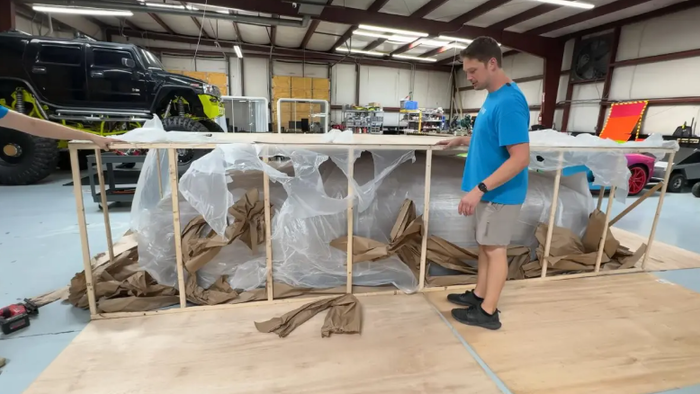
    YouTuber Carter Sharer paid $30,000 for a “Bugatti” from Temu. Everyone knows that these supercars cost millions of dollars, with a single rim and tire exceeding $30,000. But that didn’t stop Sharer, and months later, the “vehicle” arrived at his doorstep in a massive wooden crate. 

    Unboxing the China-Bugatti…

    The YouTuber and his pals then realized the vehicle was entirely made of foam.

    The quality of workmanship of the China-Bugatti was very poor. 

    Watch the full unboxing of the China-Bugatti:

    The lesson to be learned is that sellers on Temu and other shady Chinese e-commerce websites shouldn’t be trusted.  

    Loading recommendations…
  • Audience Erosion Accelerates Across Traditional TV

    Audience Erosion Accelerates Across Traditional TV

    Building on UBS’ note to clients last month, which flagged an inflection point as streaming TV recently overtook traditional TV, a new report from Goldman, citing its very own Nielsen TV ratings tracker, shows a continued steep deterioration in broadcast and cable viewership in recent weeks. 

    A team of Goldman analysts led by Michael Ng opened Monday’s note to clients with a disturbing statistic for the traditional TV industry: 

    We refresh our Nielsen TV ratings tracker for our U.S. Media coverage (DIS, CMCSA, PARA, WBD, FOXA) that includes traditional ACM (average commercial minute) prime time and total day ratings across broadcast and cable. This edition focuses on the C3 cable and broadcast ratings through week ending July 27th, 2025 (14 day delay), and L3 cable ratings through week ending August 10th, 2025.

    • Prime time commercial ratings for broadcast ex-sports were down 23% yoy in 3Q25-to-date (through week ending July 27th).

    • Prime time commercial ratings decreased 39% for broadcast including sports and declined -30% for cable, in 3Q25-to-date (through week ending July 27th).

    Some of the key takeaways from Ng’s note are that audience erosion is accelerating in both broadcast and cable compared with earlier in 2025, with even the stabilizing effect of sports unable to offset sharp primetime declines. FOX stands out as a notable exception, as strong growth at Fox News bucks the broader downturn in cable. 

    In contrast, Comcast (CMCSA) is facing the most severe collapse in cable total day viewership, plunging 49% year-over-year. Overall, the weakness in viewership is broad-based across entertainment, news, and lifestyle genres.

    CMCSA viewership declined the most QTD at -49% y/y C3Q25-to-date

    Broadcast primetime ratings (including sports) by broadcast network

    For the full report on the traditional TV viewership tracker, read the full report in the usual place

    Ng’s report builds on the UBS note we cited in early July about the inflection point reached: “Streaming surpasses traditional TV in May.”

    And perhaps the downturn in traditional TV is why mega broadcaster Sinclair, with 178 stations across 81 U.S. markets, announced earlier today a “strategic review of its broadcast business” aimed at “optimizing value creation across its portfolio.” 

    Loading recommendations…
  • Red Or Blue: AI is Coming For You

    Red Or Blue: AI is Coming For You

    Authored by Athan Koutsiouroumbas via RealClearPennsylvania,

    Is artificial intelligence coming for your job? It may depend on who you voted for in the 2024 presidential election.

    If you voted for Donald Trump, your job is likely safe.

    If you voted for Kamala Harris, you have reason to be concerned.

    Quietly last month, Microsoft released a study of the jobs most and least likely to be replaced by artificial intelligence. The study results track closely to the socioeconomics of the 2024 presidential election and the political realignment sweeping the nation.

    The jobs most likely to be displaced by artificial intelligence fit the profile of the college-educated elite who are backing the Democratic Party. These jobs include writers and authors, reporters, historians, and political scientists.

    These are roles rooted in so-called knowledge work, which is the gathering and interpreting of information, producing written content, and communicating ideas. These are the tasks artificial intelligence currently does best.

    The jobs least likely to be displaced are the blue-collar workers who are building the new Republican majority. These jobs include highway maintenance workers, cement masons, painters, and truck drivers. All roles with a high physical component and minimal overlap with AI’s current capabilities.

    Nationwide, about 8.5 million jobs are at the highest risk of being replaced by AI. Based on an analysis of Microsoft and state data, in Pennsylvania, that represents a little under 300,000 jobs. Conversely, about 5.5 million jobs nationwide, and roughly 240,000 in Pennsylvania, are in categories least likely to be affected.

    The Microsoft study’s methodology is worth noting. Researchers analyzed 200,000 anonymized conversations between Americans and Bing Copilot, classifying the “user goals” and the “AI actions” according to work activities defined by the U.S. Department of Labor’s O/NET database.

    By measuring how frequently AI assisted with or performed these activities, how successfully it did so, and how broad the potential impact was, they created an “AI applicability score” for each occupation.

    These roles share a heavy reliance on information gathering, writing, editing, and communicating, which are areas where AI already demonstrates high task completion rates and broad applicability.

    From a political standpoint, the study’s findings mirror the cultural and economic realignment of the last decade. The Democratic coalition has grown more white-collar, more urban, and more dependent on credentialed professions. The Republican base has grown more working-class, more rural or exurban, and concentrated in the skilled trades.

    In short, the jobs that AI is poised to displace are concentrated in the Democratic coalition, while the jobs still untouched by AI are clustered in the Republican one.

    The implication? AI disruption may accelerate the realignment – replacing jobs in industries that overwhelmingly vote blue while leaving red-leaning jobs largely untouched.

    But the study also warns against simple “automation doom” narratives. Many of the most at-risk occupations are not necessarily destined for elimination; they may instead be transformed. AI can assist rather than replace, potentially boosting productivity and changing job descriptions rather than eliminating them entirely.

    Still, the scale of potential change is enormous. The biggest concentration is in customer service (2.85 million nationally) and sales representatives (1.14 million nationally), which are fields where AI can already answer questions, present information, and resolve issues with impressive fluency.

    AI’s trajectory may mirror past innovations, such as ATMs, which reduced the need for tellers but also enabled banks to expand and redeploy staff. The Microsoft study suggests we may see similar patterns with AI.

    Yet the cultural dimension is new: automation risk is not spread evenly across the political spectrum. It clearly clusters along partisan lines.

    Pennsylvania, poised to become the “AI capital of the United States,” will be both the factory floor and the test lab for this disruption – producing the tools that may displace thousands of its own white-collar workers while expanding opportunity for skilled trades.

    For policymakers, the challenge is twofold: they should provide soft landings for those being displaced while ensuring our educational system is producing enough workers with the necessary blue-collar skills to usher in the economy of the future.

    During the era of globalization, policymakers demonstrated they either did not care or could not help the millions of displaced industrial workers who anchored the American middle class.

    This is an opportunity for GOP policymakers to rise to the occasion to bring even more Americans into its Big Tent by providing solutions for these soon-to-be displaced workers, largely concentrated in the suburbs. 

    The study ends on a note of humility as AI’s impact is a moving target. Capabilities will evolve, jobs will adapt, and new occupations will emerge. While truck drivers are on the “safe” list today, self-driving trucks are not far away. 

    Want to know if AI is coming for your job?  Pull up a county-by-county map of the 2024 election. You might find your answer in red and blue.

    Loading recommendations…
  • Intel Shares Surge 5% as CEO Visits White House Amid Trump Resignation Demand

    Intel Shares Surge 5% as CEO Visits White House Amid Trump Resignation Demand

    Update 0900EST: Shares of Intel are up about 5% at the cash open on Monday following the announcement that the company’s CEO will head to the White House to speak with President Trump today.

    Regardless of the outcome of Intel CEO Lip-Bu Tan’s meeting with President Trump today, the stock remains one to watch as Trump pushes to keep American companies—particularly in strategic sectors like semiconductors and rare earth minerals—closely aligned with the government.

    Just last week, we asked whether Intel could be the next MP Materials, in which the government took a private stake last month. With Intel standing as the only truly critical U.S.-based semiconductor manufacturer, the company appears poised to benefit from a potential policy tailwind, no matter who sits in the CEO’s chair.

    Intel CEO Lip-Bu Tan is headed to the White House today, just days after President Trump publicly demanded his resignation over alleged ties to China. Sources close to The Wall Street Journal say Tan will discuss his personal and professional background with the president, emphasize his allegiance to America, and advocate for closer government and Intel cooperation. 

    Tan is a Malaysian-born/American citizen and has worked in the tech industry for years. He recently took over as CEO of the struggling chip company to revive it and position it for a turnaround. 

    But his tenure has already seen turmoil and political scrutiny.

    Concerns stem from Cadence Design Systems, where Tan was CEO until 2021. Last month, Cadence agreed to pay $140 million to settle DOJ charges for selling chip-design tools to a Chinese military university.

    Optics so far are unfavorable for Tan, especially against the backdrop of the “America First” movement.

    Here’s more from the sources about Tan’s upcoming meeting with Trump:

    Tan is expected to have a wide-ranging conversation with Trump, with the intent of explaining his personal and professional background, the people said. He could also propose ways that the government and Intel could work together, they said.

    Tan hopes to win Trump’s approval by showing his commitment to the country and pledging the importance of keeping Intel’s manufacturing capabilities as a national security issue, one of the people said.

    The controversy surrounding Tan began last Thursday after President Trump read U.S. Republican Senator Tom Cotton’s letter sent one day earlier to Intel’s Board about the CEO’s ties to Chinese firms.

    This led to Trump firing off a Truth Social post: “The CEO of INTEL is highly CONFLICTED and must resign, immediately.”

    After today’s meeting, it’s likely only a matter of time before the White House announces “golden shares” in Intel – just as it did in the U.S. Steel-Nippon deal.

    High teens appear to be the floor. 

    . . .

    Loading recommendations…
  • Tesla's European Sales Slump Continues Into August

    Tesla's European Sales Slump Continues Into August

    Authored by Tom Ozimek via The Epoch Times,

    Tesla’s sales slump in Europe extended into August, with sharp declines in key markets underscoring the U.S. electric vehicle (EV) maker’s struggles against rising Chinese competition and a consumer backlash against CEO Elon Musk.

    Fresh data from French car industry group Plateforme automobile show Tesla registrations down by 47.3 percent year-over-year in August, while the overall French passenger car market rose by 2.2 percent to 87,850 vehicles.

    Over the first eight months of 2025, French new-car registrations were down by 7.1 percent, although Tesla’s 39.4 percent drop far outpaced the market.

    The picture was even bleaker across the Nordic countries. In Sweden, Tesla registrations plunged by 84.4 percent, according to industry association Mobility Sweden, while overall sales climbed by 6 percent. Denmark saw Tesla down by 42 percent. The Netherlands registered a 50 percent slide.

    The only bright spots were Norway and Spain, although even there, Tesla lagged behind Chinese rival BYD. In Norway, where nearly all new cars sold are electric, Tesla gained 21.3 percent in August. But BYD’s sales soared by 218 percent, cementing its position as the fastest-growing EV brand in Scandinavia.

    In Spain, Tesla’s sales jumped by 161 percent to 1,435 vehicles, in part because of generous subsidies. However, BYD outsold Tesla with 1,827 vehicles, a 400 percent increase. Year-to-date, BYD sales in Spain surged by 675 percent to 14,181 units. Tesla saw a more modest 11.6 percent rise to 9,303. Some analysts cautioned that Tesla’s August spike may have been inflated by the timing of shipments. Andy Leyland, co-founder of supply chain specialist SC Insights, said that when quarterly numbers that run through the end of September are published, a clearer picture of Tesla sales will emerge.

    Broader Slide

    Tesla’s August weakness in some key European markets followed steep declines in July in Europe’s two largest auto markets. The company’s UK sales fell by nearly 60 percent to 987 vehicles, while German registrations fell by 55 percent to 1,110, according to national industry bodies. For the first seven months of 2025, Tesla’s German sales were down by almost 58 percent to 10,000 units.

    In the same period, BYD’s UK sales increased nearly fourfold to 3,184, and German sales jumped almost fivefold to 1,126.

    Data from the European Automobile Manufacturers’ Association show that Tesla has now lost market share in Europe for seven consecutive months, with registrations down by 42.4 percent year-over-year in July.

    Analysts say Tesla’s problems in Europe reflect both market dynamics and brand perception. The company has not introduced a new mass-market model since the Model Y in 2020, while competitors have flooded the market with fresh offerings.

    “One reason we are continuing to see disappointing Tesla volumes can partially be attributed to a more competitive market environment,” said Matthias Schmidt of Schmidt Automotive Research.

    Tesla executives have previously expressed the view that declining sales reflected a production switch to the revamped Model Y, which was Europe’s bestselling car in 2023. Deliveries began in June, but the model has struggled: August sales of the Model Y fell by 46.5 percent in Denmark and by 87 percent in Sweden.

    Tesla’s slump in Europe comes on the heels of weak quarterly results. The company reported a 12 percent year‑over‑year drop in total revenue to $22.5 billion, its steepest decline in a decade, and a 42 percent decline in operating income to $923 million.

    Musk told investors on an earnings call that Tesla may face “a few rough quarters” amid shifting tariffs, expiring EV tax credits in the United States, and evolving regulatory frameworks for autonomous driving.

    Loading recommendations…
  • OpenAI Brings GPT-4o Back After Users Revolt Over GPT-5

    OpenAI Brings GPT-4o Back After Users Revolt Over GPT-5

    Update: 

    *  *  *

    OpenAI has brought back GPT-4o following the rollout of their latest GPT-5 model, after users complained that the new model was lame in comparison. 

    The company advertised the new model as the “smartest, fastest, most useful model yet,” which uses a “real-time router” to switch between more efficient models for basic questions vs. deeper reasoning for more complex demands. 

    During a Reddit AMA, OpenAI CEO Sam Altman responded to a question by saying that GPT-5’s writing quality is better than previous models – only to have several Redditors say the new model felt “sterile” and “much worse” – and answered “briefly and dryly,” according to engadget

    “We for sure underestimated how much some of the things that people like in GPT-4o matter to them, even if GPT-5 performs better in most ways,” Altman posted on X.

    The return of GPT-4o was celebrated, but there’s still no guarantee that OpenAI will keep its older model around indefinitely. In the same X post, Altman said that OpenAI “will watch usage as we think about how long to offer legacy models for.” In the meantime, OpenAI is focusing on finishing the GPT-5 rollout and making changes that will “make it warmer.” However, for users who have grown attached to GPT-4o as more than just an AI chatbot, this could be the beginning of the end.

    OpenAI called GPT-5 a ‘significant upgrade’ which used PhD-level intelligence and amazing coding skills, only for users to immediately complain.

    “I’ve been trying GPT5 for a few days now. Even after customizing instructions, it still doesn’t feel the same. It’s more technical, more generalized, and honestly feels emotionally distant,” wrote one Redditor. “Kill 4o isn’t innovation, it’s erasure.”

    “Sure, 5 is fine—if you hate nuance and feeling things,” wrote another user. 

    On Friday, Altman took to X to say that the company would keep the previous model running for Plus users, and promised to implement fixes to improve GPT-5’s performance and user experience.

    Altman also promised to double GPT-5 rate limits for ChatGPT Plus users, saying “We will continue to work to get things stable and will keep listening to feedback.” 

    As Wired notes further; The backlash has sparked a fresh debate over the psychological attachments some users form with chatbots trained to push their emotional buttons. Some Reddit users dismissed complaints about GPT-5 as evidence of an unhealthy dependence on an AI companion.

    In March, OpenAI published research exploring the emotional bonds users form with its models. Shortly after, the company issued an update to GPT-4o, after it became too sycophantic.

    It seems that GPT-5 is less sycophantic, more “business” and less chatty,” says Pattie Maes, a professor at MIT who worked on the study. “I personally think of that as a good thing because it is also what led to delusions, bias reinforcement, etc. But unfortunately many users like a model that tells them they are smart and amazing, and that confirms their opinions and beliefs, even if [they are] wrong.”

    h/t Capital.news

    Loading recommendations…
  • Wild Theories Abound Over Gigantic "Comet" Careening Through Our Solar System In The Fall

    Wild Theories Abound Over Gigantic "Comet" Careening Through Our Solar System In The Fall

    Authored by Michael Snyder via TheMostImportantNews.com,

    A colossal interstellar space rock that was originally known as “A11pl3Z” but has since been given the designation “3I/ATLAS” will be making a very alarming run through our solar system in September and October.  Based on their initial observations, scientists estimated that 3I/ATLAS has a diameter of approximately 20 kilometers, and that would make it larger than Manhattan.  But now scientists are telling us that it is probably at most 5.6 kilometers wide.  Even if it is only about 5 kilometers wide, we are still talking about an extinction-level event if it were to hit us.

     Over the next couple of months, 3I/ATLAS will be zipping through our solar system at a speed of about 130,000 miles per hour, and scientists assure us that the gravity of the sun cannot significantly alter the trajectory of anything moving that fast.  

    But what if they are wrong?

    As you will see below, 3I/ATLAS is supposed to fly past Mars at a distance of just 0.19 AU on October 3rd.

    That is even closer than astronomers were originally projecting, and that is making some people nervous.

    Hopefully the experts are correct and there is no threat of collision, because if this thing actually hit Mars it would be a cataclysm unlike anything that any of us have ever seen.

    According to Harvard astrophysicist Avi Loeb, it appears that 3I/ATLAS may actually be emitting its own light

    Interstellar object 3I/ATLAS — which is zooming through our inner solar system — appears to be emitting its own light, according to Harvard astrophysicist Avi Loeb.

    The observation by Loeb, if verified, would contradict NASA’s classification of the Manhattan-size object as a comet, the scientist argues in a new blog post.

    Obviously, more observations will have to be done in order to confirm this.

    But there are essentially two options.

    If this theory is not true and 3I/ATLAS is not emitting its own light, Loeb says that this giant space rock is probably about 12 miles long

    If 3I/ATLAS were reflecting light, it would mean the object was 12 miles long, which is improbable, according to the astrophysicist.

    I cannot even imagine an object that is 12 miles long and that is traveling at 130,000 miles per hour.

    Can you?

    The second option is that 3I/ATLAS is emitting its own light, and that would be even more ominous, because Loeb believes that 3I/ATLAS could potentially be “a spacecraft powered by nuclear energy”

    Loeb speculated that the nucleus of the object could in fact be nuclear — and possibly an engine crafted by an alien people.

    “A natural nuclear source could be a rare fragment from the core of a nearby supernova that is rich in radioactive material. This possibility is highly unlikely, given the scarce reservoir of radioactive elements in interstellar space,” Loeb wrote.

    “Alternatively, 3I/ATLAS could be a spacecraft powered by nuclear energy, and the dust emitted from its frontal surface might be from dirt that accumulated on its surface during its interstellar travel,” Loeb conjectured, adding, “This cannot be ruled out, but requires better evidence to be viable.”

    And Loeb has pointed out that the fact that the trajectory of 3I/ATLAS will take it so close to Mars, Venus and Jupiter is more evidence for the theory that it could be an alien spacecraft…

    Loeb has also raised questions about its unusual trajectory.

    “If you imagine objects entering the solar system from random directions, just one in 500 of them would be aligned so well with the orbits of the planets,” Loeb told Fox News Digital earlier this month.

    The interstellar object, which comes from the center of the Milky Way, is also expected to pass near Mars, Venus and Jupiter, another improbable coincidence, he said.

    “It also comes close to each of them, with a probability of one in 20,000,” he said.

    For the record, I think that Loeb is way out in left field on this.

    I do not believe that 3I/ATLAS is an alien spacecraft.

    But I do believe that it is a very dangerous space rock.

    And it does appear that it will travel alarmingly close to Mars, Venus and Jupiter

    It follows a retrograde orbit aligned within 5 degrees of the ecliptic plane, passing close to Venus at 0.65 astronomical units, Mars at 0.19 AU, and Jupiter at 0.36 AU. Loeb calculates the probability of such alignments at 0.005 percent for random arrivals.

    When I originally wrote about this giant space rock, we were being told that it would pass Mars at a distance of approximately 0.4 AU.

    But now we are being told that it will pass Mars at a distance of just 0.19 AU on October 3rd.

    I know that is still a relatively safe distance, but it is a little too close for comfort in my book.

    And could it be possible that our astronomers will modify their projections again as we get closer to October 3rd?

    They have already more than halved the projected distance between 3I/ATLAS and Mars.

    This is a story that we will want to watch very closely.

    Following the close encounter with Mars, 3I/ATLAS is expected to be closest to the Sun on October 30th.

    Subsequently, 3I/ATLAS is supposed to come closest to Earth on December 19th at a distance of approximately 1.8 astronomical units.

    That is very good news, because as I pointed out in a previous article, it has been estimated that if a giant space rock that is just 11 or 12 kilometers wide hit us it would “wipe out most everything on Earth”

    For an asteroid to wipe out most everything on Earth, it would have to be massive. Scientists estimate it would take an asteroid about 7 to 8 miles (11 to 12 kilometers) wide crashing into the Earth. Once it made impact, it would create a tremendous dust plume that would envelope the entire planet, block out the sun and raise temperatures where the asteroid made impact. Billions would die, and much of life on the planet would be destroyed. But, scientists believe some would survive.

    Thankfully, 3I/ATLAS is not going to hit us, but the clock is certainly ticking for humanity.

    In fact, even mainstream scientists are now warning that humanity is living on borrowed time

    In a game of Russian roulette with a standard Colt revolver, the chances of instant death are one-in-six.

    Terrifyingly, that’s the same as the odds of humanity being wiped out within 75 years – everyone dead in a cataclysmic and total breakdown of civilisation, according to Oxford University futurologist Toby Ord, an expert on the threat of artificial intelligence.

    Does it sound impossibly bleak? His colleague Nick Bostrom is more pessimistic still. He rates the possibility of human extinction by the next century as one in four.

    Pulitzer prize-winning writer Jared Diamond is even less hopeful, predicting our species’ chances of survival beyond 2050 – just 25 years away – are no better than evens, or 50/50.

    Our self-destructive behaviors are slowly but surely killing our civilization in thousands of different ways.

    So even if we are extremely fortunate and a giant space rock does not hit our planet in any of our lifetimes, the truth is that our civilization would still be facing one existential crisis after another.

    Michael’s new book entitled “10 Prophetic Events That Are Coming Next” is available in paperback and for the Kindle on Amazon.com, and you can subscribe to his Substack newsletter at michaeltsnyder.substack.com.

    Loading recommendations…
  • Security Expert Reveals Hacker Could Remote Control Cars Through Major Automaker's 'Dealership Portal'

    Security Expert Reveals Hacker Could Remote Control Cars Through Major Automaker's 'Dealership Portal'

    How a Car Dealership Portal Became a Doorway for Evil Riders

    The recent discovery by a leading security researcher has sent a chill down the spine of every automobile owner in America. The story is simple but frightening: a major carmaker’s digital doorway, meant to help dealerships run smoothly, was opened wide enough for bad guys to pry in. From that portal, a hacker could guide a vehicle to turn on, off, or even drive itself from a far‑away place.

    What You Need to Know

    • Dealerships used a portal to manage parts, inventory, and sales. It also connected to the cars themselves.
    • Security researchers found a flaw that let anyone log in without a password.
    • Once inside, the attacker could command a car’s electronic systems remotely.
    • In the wrong hands, this means cars could be hijacked from space.

    The Researcher’s Game Plan

    The person who lifted the curtain is not a professional hacker but a seasoned security analyst. He started by looking at how dealerships signed on online. A simple test: enter a blank username and a random string as a password. Windows find out that the portal accepted the entry.

    That wasn’t almost a mistake. It was a design hole that let the portal think anyone could enter. The researcher noted it carefully and submitted the data to the car manufacturer. The company apologized and said it would patch the bug quickly.

    But the driver of the story is that the portal also let the computer talk to the car itself. A bad guy could use that connection and send instructions that the car would obey.

    Imagine a Remote Hitchhiker

    Companies usually lock their cars’ computer down. They do this to keep thieves from forced theft or to help dealers after a faulty part. What this portal gave hackers was a way to talk directly to the body of a car – the engine, brakes, and center control unit. A hacker could, for example, brake the car suddenly or steer it without the owner noticing. Whether the car was parked or on a road, the attacker had a key.

    Because modern cars can even take other cars’ messages sent over the internet, you can almost picture a hacker somewhere overseas sending a command that a car in Miami lights up and drives off.

    The Why Is It Terrifying?

    “If I could switch it on from New York or push the brakes while someone was on a highway, it would feel like turning a video game into a safety nightmare,” said a top accident prevention advocate. The problem isn’t only slowing down cars. Vehicles could do dangerous moves that caused real accidents. It also dented the trust people had in cars.

    For people in an era of self‑driving dreams, this kind of vulnerability opens the door for slower thieves, who will do anything to create drama.

    What Dealers and Car Makers Are Doing Now

    After the researcher’s report, the car maker gave an official fix. The fix made the portal requirement “strong password” mandatory. The deployment was almost done in six weeks. They also had a cancellation plan, so that any account already open without a password would not stay private anymore.

    Dealership software companies listened. They updated their systems and pushed new patches. The challenge was the early version buyers, who still held a weaker version, and their software had to be reprogrammed.

    New Safety Guards

    Other car makers increased the guarding of their online portals. They banned any sign‑ins that were not typed fast enough, a tactic often used by bots. They pushed an extra layer that says: “Are you a human or a software?” It also made sure that the device you’re using is a known one.

    We’re Taking It Seriously

    In recent months, the government is urging firms to add a “security culture” step. When you design an online portal, it should have an automatic password reset that is hard for hackers to guess. The system’s internal code is checked for leaks to data that could help them.

    Experts also stress that the car manufacturers should not just rely on the portal alone. A separate call‑center must exist. Each of these rules protects one layer of the digital wall.

    What You Can Do as a Consumer

    • Ask your dealer how they protect your vehicle’s data.
    • Check if the dealership uses secure log‑in systems.
    • Ask for a regular “audit” that shows the dealership’s security works.
    • If you find a mistake, let the dealer know quickly.

    From Humble Startups to National Threats

    But the danger is not only automotive. The same type of flaw is found in many small companies that sell equipment online. A simple “by‑pass” gives the attacker level control. A laptop, a small CNC machine, or a brand new solar panel could be hijacked because its network reaches the internet.

    That’s why the American infrastructure is a priority. Every dumb or thief can find a path to break into the system. They do that in a weekend by hacking into the portal and then turning them into a remote threat.

    Prevention Takes More Than a Patch

    Many argue that simply making the portals stronger is not enough. A huge change is to see each system as a critical point. You must built an “envelop” system around it, and you should test it with peers. The idea is not so much that a thief is completely stopped – it is about faking the user’s environment, such that the portal is made to keep a hold on the user’s computer and data.

    Finally, keep an eye on the “industry.” Manufacturers’ industry updates every 6‑th week for each patch and should just keep a note on any new top of the security roadmap. It is part of a bigger change. The ambition is to guarantee that all the systems are free from a huge gap of digital because a vulnerability can cause them to be damaged for future years.

    One Person’s Role in the Fight

    There are individuals not just on the corporate side but on the consumer side. They help by asking questions. They ask: “Where does my car’s data live?” They are good at looking for system details. They help designers. They help make an everyday driver real, improving cars for safety, and future.

    One way to replicate the problem is to not ask the car manufacturer to try to fix also. When you do that, the problems will happen again. That is why it is a request. The decision is to not create a vulnerable platform, that is not a risky place at the buyer side.

    Key Take‑aways

    1. Portal access was open so a bad guy could go to any vehicle on a remote route.
    2. Car makers fixed it quickly, but the risk is not over. The vehicle dashboard might be threatened by new hacking attack.
    3. Dealerships must do a digital immigration to keep all customers’ data from leaking to the outer world.
    4. Consumers might ask their dealer for an audit of the portal’s safety standard.
    5. It is vital for the way of the IT infrastructure policy to a number of layers of security rising. That includes the portal, device, and the response to section of state.

    In the end, everybody should do a double take. It is not just a threat, but it is opportunity. The
    challenge is how every person can be proud that their own vehicle is also safe for instance and it can’t literally do stands something beyond necessity to safeguard.

    Breaking News: A Car Company’s Big Security Slip‑Up

    When a hacker named Eaton Zveare discovered a nasty flaw in a car company’s online portal, the world took notice. He told TechCrunch that a few weak points in the system could let bad guys grab private data, lock cars, and even drive them from far away. That’s scary. The driver company never said its name, but it runs a lot of popular brands. Millions of Americans could have been in danger.

    How Did the Hacker Find the Problem?

    Zveare has experience finding hidden bugs in retailers’ systems. Earlier this year, while working on a weekend project, he spotted a login bug. The portal allowed anyone to create a “national admin” account. That’s a key mistake: the code that checks the login lives inside the user’s web browser. When Zveare opened the login page, he could change that code. In doing so, he bypassed the entire security check. He now had full access to dealer data, finances, leads and personal information.

    What Did He Do With the Access?

    At first, Zveare used the hack to control a friend’s car. He grabbed the vehicle’s data, unlocked it, and tried it out. He says he could do this to any driver. He only needed a name to trigger the hack. He even wrote that he could find a car in a parking lot and seize it. In the words of his own account:

    “No one knows you’re silently looking at all of these dealers’ data. All their financials, all private info, all leads.”

    He warned that the hack was a real nightmare that could happen to anyone. The vulnerability was a trade‑off between authentication and data safety.

    What Happened After the Reveal?

    Once the car company learned about the problem, they acted fast. They fixed the key weaknesses in February 2025, in less than a week. Zveare praised the company’s quick response. He said the issue involved only two simple API flaws. If those are wrong, everything goes wonky.

    Key Lessons From the Incident

    • The importance of tool security.
    • The strength of login checks.
    • The danger of trusting code on the client side.

    He concluded that the car company and the entire sector must fix the gaps in their authentication systems if they want to keep Americans safe from hackers.

    Why This Matters for All of Us

    The hacker’s message was simple. The bad guys can sit behind a computer screen and take control of a car anywhere. This means:

    • Personal information can be stolen.
    • Vehicles can be moved or locked without permission.
    • Financial details for car owners and dealers are at risk.

    America’s auto industry shares a similar problem. Many firm’s software has the same common weakness. A hacker can get in, see a user’s data, and block or even start the car. Now, the industry can’t ignore it. The time to fix is now.

    What You Can Do to Stay Safe

    • Use strong passwords.
    • Do not share login details.
    • Keep software up to date.
    • Check your vehicle software updates.
    • Pay attention to security notices from the manufacturer.

    By supporting better security and staying vigilant, we can protect ourselves from these new threats. The incident with Eaton is the tip of the iceberg. The notice reminds everyone that attackers can easily turn software into a tool for chaos. This is a wake‑up call for the auto world and handlers. The quicker the industry implements fixes, the more we can stay safe.

    What We Expect Next

    As soon as the company claims the flaw’s fixed, the industry will give a morale boost to all stakeholders. Tech firms and governments will look closely. Unfortunately, the reality is not the end. Developers will probably rewrite the log‑in mechanics and test the portal again. They must keep a proper audit of all APIs. The answer is to keep security on top of the design. The next step is bigger teams of security researchers helping develop secure controllers and adding real‑world testing. For the drivers on the road, the next important point is to keep computers clean, to stay away from suspicious links, and to stay in touch with car support teams. The final hope is that the auto industry embraces the security culture at the same speed as it accepts AI tools. Customers want protection; companies want to win trust. The new ethics of security will make sure that the next big problem is far shorter than this one.

    In conclusion, the rollout of the big security flaw and its swift fix gives a deep lesson. Weak login checks can become a gateway for the entire system. Secure coding, quick patches, and responsible handling of data are crucial. It’s not just about a clever hacker but about how companies protect us on every click and swipe. The data behind the door is too valuable to leave open.

    Takeaway: Keep Your Car, Keep Your Data Safe

    When the world is moving toward electrified and connected vehicles, the safe use has to rise in the same way. All drivers, both for well‑known brands or not, need to:

    • Ask for real security updates.
    • Watch for new patches about software updates.
    • Make sure the company’s portal is secure.
    • Keep confidential information locked.
    • Ask for help if something is suspicious.

    We’ll remember how this was discovered. It was a danger in plain sight. Yet the fix was swift and simple. A good reminder that we need security to protect the people who trust us with their cars and lives. Nothing is beyond best effort to keep the best possible safety. The end.

  • AI-Powered Radar Can Now Spy On Your Phone Calls From 10 Feet Away

    AI-Powered Radar Can Now Spy On Your Phone Calls From 10 Feet Away

    Oh great, more surveillance!

    A team of Penn State computer scientists has cooked up a chilling new way to eavesdrop: detecting the microscopic vibrations your smartphone gives off during a call and translating them into words using artificial intelligence.

    The method relies on millimeter-wave radar, the same high-frequency tech powering self-driving car sensors, motion detectors, and 5G networks. Aim it at a phone and it can capture the subtle tremors from the earpiece when someone is speaking. These vibrations are invisible to the naked eye but, with the right tools, can become a transcript of your conversation.

    The radar data is run through a modified version of Whisper, an AI speech-recognition model originally designed for clean audio. Instead of retraining the whole system, the team used a low-rank adaptation trick to tweak just 1% of the model’s parameters – enough to boost performance without starting from scratch.

    The result? Roughly 60% accuracy on continuous speech from up to 10 feet away, covering a vocabulary of about 10,000 words. It’s not perfect, but it’s plenty to grab key phrases, names, or numbers that could be pieced together to expose private information.

    “When we talk on a cellphone, we tend to ignore the vibrations that come through the earpiece and cause the whole phone to vibrate,” said Suryoday Basak, the project’s lead researcher and a doctoral candidate in computer science, adding “If we capture these same vibrations using remote radars and bring in machine learning… we can determine whole conversations.”

    This is an evolution of a 2022 project where the same team could only identify 10 pre-set words with 83% accuracy. Now, they’ve moved into the far more complex world of live speech.

    As Interesting Engineering notes further; 

    Radar tech breakthrough

    The experimental setup involved positioning the radar sensor about three meters (10 feet) away from the phone to capture the minute vibrations.

    The data was then fed into the customized AI model, which produced transcriptions with around 60 percent accuracy over a vocabulary of up to 10,000 words.

    While this is far from perfect, the researchers noted that even partial keyword matches could have serious security implications.

    “The result was transcriptions of conversations, with an expectation of some errors, which was a marked improvement from our 2022 version, which outputs only a few words,” said co-author Mahanth Gowda, associate professor of computer science and engineering.

    “But even picking up partial matches for speech, such as keywords, are useful in a security context.”

    The team compared their approach to lip reading, which typically captures only 30% to 40% of spoken words but can still help people infer conversations when combined with context.

    Similarly, the radar-AI system’s output, though imperfect, can reveal sensitive information when supplemented with prior knowledge or manual correction.

    Privacy risks amplified

    Basak emphasized the potential privacy risks posed by this emerging technology.

    “Similar to how lip readers can use limited information to interpret conversations, the output of our model combined with contextual information can allow us to infer parts of a phone conversation from a few meters away,” he said.

    “The goal of our work was to explore whether these tools could potentially be used by bad actors to eavesdrop on phone conversations from a distance. Our findings suggest that this is technically feasible under certain conditions, and we hope this raises public awareness so people can be more mindful during sensitive calls.”

    The U.S. National Science Foundation supported the research, and the team stressed that their experiments are intended to highlight possible vulnerabilities before malicious actors exploit them.

    They envision future efforts to develop protective measures to secure personal conversations from this kind of remote surveillance.

    As wireless technology and AI evolve rapidly, this study serves as a crucial warning: even the faintest vibrations from your everyday devices can potentially betray your most private words.

    The study has been published in, published in the Proceedings of WiSec 2025: 18th ACM Conference on Security and Privacy in Wireless and Mobile Networks.

    Loading recommendations…
  • After 18 Years Without A Voice, AI-Powered Brain Implant Helps Stroke Survivor Speak Again

    After 18 Years Without A Voice, AI-Powered Brain Implant Helps Stroke Survivor Speak Again

    At age 30, Ann Johnson’s life in Saskatchewan was full. She taught math and physical education at a high school, coached volleyball and basketball, and had recently married and welcomed her first child. At her wedding, she delivered a 15-minute speech filled with joy.

    Everything changed in 2005, when she suffered a brainstem stroke while playing volleyball with friends. The stroke left her with locked-in syndrome – near-total paralysis and an inability to speak. “She would try to speak, but her mouth wouldn’t move and no sound would come out,” researchers said. For nearly two decades, she communicated slowly using an eye-tracking system, spelling out words one letter at a time.

    In 2022, Johnson became the third participant in a clinical trial run by researchers at the University of California, San Francisco, and the University of California, Berkeley. The project aimed to restore speech using a brain-computer interface, or neuroprosthesis, that bypasses the body’s damaged connections.

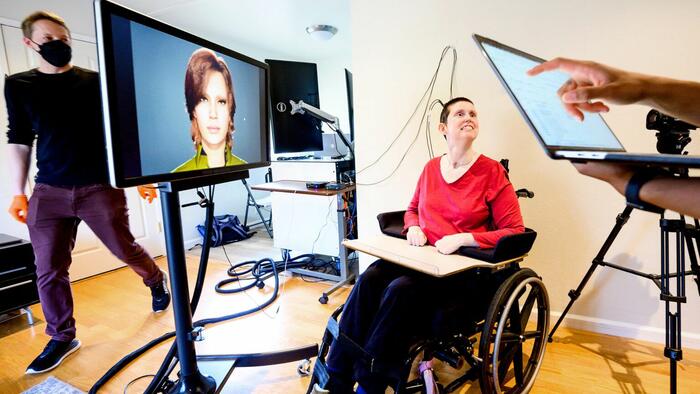
    Ann Johnson became paralyzed after a brainstem stroke in 2005, at age 30. As the third participant in a clinical trial led by researchers at UC Berkeley and UC San Francisco, she heard her voice again in 2022, the first time in 18 years. Noah Berger, 2023

    We were able to get a good sense of the part of the brain that is actually responsible for speech production,” said Gopala Anumanchipalli, an assistant professor at UC Berkeley who began the work in 2015 as a postdoctoral researcher with Edward Chang, a UCSF neurosurgeon. “From there, they figured out how to computationally model the process so that they could synthesize from brain activity what someone is trying to say.”

    The device records signals from the brain’s speech centers, sending them to an AI model trained to translate the activity into text, sound, or even facial animation. “Just like how Siri translates your voice to text, this AI model translates the brain activity into the text or the audio or the facial animation,” said Kaylo Littlejohn, a Ph.D. student and co-lead on the study.

    To give Johnson an embodied experience, researchers had her choose from a selection of avatars, and they used a recording of her wedding speech to recreate her voice. An implant plugged into a computer nearby rested on top of the region of her brain that processes speech, acting as a kind of thought decoder. Then they showed her sentences and asked her to try to say them.

    “She can’t, because she has paralysis, but those signals are still being invoked from her brain, and the neural recording device is sensing those signals,” said Littlejohn. The neural decoding device then sends them to the computer where the AI model resides, where they’re translated. “Just like how Siri translates your voice to text, this AI model translates the brain activity into the text or the audio or the facial animation,” he said. –Berkeley.edu

    For Johnson, the trial was emotional. “What do you think of my artificial voice? Tell me about yourself. I am doing well today,” she asked her husband during one session. The researchers had used a recording of her wedding speech to recreate her voice and paired it with a digital avatar she had chosen.

    We didn’t want to read her mind,” Anumanchipalli emphasized. “We really wanted to give her the agency to do this. In some sessions where she’s doing nothing, we have the decoder running, and it does nothing because she’s not trying to say anything. Only when she’s attempting to say something do we hear a sound or action command.”

    The early version of the system had an eight-second delay between prompting Johnson and producing speech. But a March study in Nature Neuroscience described a streaming architecture that reduced that to about one second, enabling near-real-time translation. While the avatar in earlier tests bore only a passing resemblance to her, researchers say more lifelike 3D photorealistic versions are possible. “We can imagine that we could create a digital clone that is very much plugged in … with all the preferences, like how Zoom lets us have all these effects,” Anumanchipalli said.

    Johnson’s implant was removed in February 2024 for reasons unrelated to the trial, but she continues to advise the research team. She has urged them to develop wireless implants and told them the streaming synthesis “made her feel in control.”

    Looking ahead, Anumanchipalli said the goal is for neuroprostheses to be “plug-and-play” and part of standard medical care. “If that means they have a digital version of themselves communicating for them, that’s what they need to be able to do,” he said.

    Johnson hopes to work as a counselor in a physical rehabilitation facility, ideally using such a device. “I want patients there to see me and to know their lives are not over now,” she wrote to a UCSF reporter. “I want to show them that disabilities don’t need to stop us or slow us down.”

    Loading recommendations…
  • Musk Takes On Apple, OpenAI In Antitrust Showdown Over Chatbots

    Musk Takes On Apple, OpenAI In Antitrust Showdown Over Chatbots

    Elon Musk’s X and xAI have filed a federal lawsuit in Fort Worth, Texas, accusing Apple and OpenAI of “locking up markets” to preserve their monopolies and shut out rivals. This comes as Musk’s long-running feud with OpenAI chief Sam Altman intensifies.

    The lawsuit centers on Apple’s recent deal to make OpenAI’s ChatGPT the only generative AI chatbot on the iPhone’s operating system, effectively shutting out xAI’s Grok and other rivals, such as Google’s Gemini and Anthropic. 

    The lawsuit’s introduction argues that Apple and OpenAI have teamed up to protect their monopolies in smartphones and AI chatbots:

    This is a tale of two monopolists joining forces to ensure their continued dominance in a world rapidly driven by the most powerful technology humanity has ever created: artificial intelligence (“AI”). Working in tandem, Defendants Apple and OpenAI have locked up markets to maintain their monopolies and prevent innovators like X and xAI from competing.1 Plaintiffs bring this suit to stop Defendants from perpetrating their anticompetitive scheme and to recover billions in damages.

    AI is fundamentally reshaping our world. Technology powered by AI has not only become embedded in our daily lives but is also transforming critical sectors like healthcare, education, and finance. The consensus among global business leaders, academics, and scientists is that AI adoption is both unavoidable and transformational—and businesses that do not plan for it risk falling behind.

    As Apple now recognizes, AI poses an existential threat to its business. For example, AI is rapidly advancing the rise of “super apps”—i.e., multi-functional platforms that offer many of the services of smartphones, such as social connectivity and messaging, financial services, e-commerce, and entertainment—that do not require a customer to be tied to a particular device. In other words, super apps, like those being developed by X and xAI, stand ready to upend the smartphone market and Apple’s entrenched monopoly in it.

    The writing is on the wall. Apple’s Senior Vice President for Services, Eddy Cue, has expressed worries that AI might destroy Apple’s smartphone business, just as Apple’s iPhone did to Nokia’s handsets.

    Apple knows it cannot escape the inevitable—at least not alone. In a desperate bid to protect its smartphone monopoly, Apple has joined forces with the company that most benefits from inhibiting competition and innovation in AI: OpenAI, a monopolist in the market for generative AI chatbots.

    OpenAI quickly rose to dominance in the generative AI chatbot market after introducing its flagship service, ChatGPT, in 2022. Today, OpenAI controls at least 80 percent of the market. Because of OpenAI’s monopoly, other generative AI chatbots have struggled to gain share. xAI’s Grok has yet to gain more than a few percent of the market despite accolades about its superior features. 

    Just like Apple, OpenAI has incentive to protect its monopoly by thwarting competition and innovation in the generative AI chatbot market. And just like Apple, it has done so in violation of the antitrust laws.

    In June 2024, Apple and OpenAI announced that Apple would integrate OpenAI’s ChatGPT into Apple’s iPhone operating system (“iOS”). Apple and OpenAI’s exclusive arrangement has made ChatGPT the only generative AI chatbot integrated into the iPhone. This means that if iPhone users want to use a generative AI chatbot for key tasks on their devices, they have no choice but to use ChatGPT, even if they would prefer to use more innovative and imaginative products like xAI’s Grok. An OpenAI strategy document recognized the importance of competition in this emerging and transformational space: “Real choice drives competition and benefits everyone. Users should be able to pick their AI assistant.” Yet Apple and OpenAI have colluded to prevent exactly that.

    X and xAI argue:

    If not for its exclusive deal with OpenAI, Apple would have no reason to refrain from more prominently featuring the X app and the Grok app in its App Store. 

    Just a few weeks ago, Musk threatened Apple with legal action over alleged antitrust violations regarding the App Store rankings of the Grok AI chatbot. He wrote in an X post that Apple’s behavior “makes it impossible for any AI company besides OpenAI to reach #1 in the App Store.”

    Musk is seeking an injunction to block Apple and OpenAI’s exclusive chatbot deal and billions in damages. If successful, the case could reshape how AI bots are distributed on smartphones. 

    Loading recommendations…
  • Apple Plans AI Robots, Smarter Siri And Home Devices In Bid To Regain Momentum

    Apple Plans AI Robots, Smarter Siri And Home Devices In Bid To Regain Momentum

    Apple is preparing a sweeping lineup of new hardware as part of a broader push into artificial intelligence and the smart home, according to people familiar with the plans. The centerpiece is a tabletop robot, targeted for release in 2027, that is designed to act as a lifelike virtual companion. The company is also developing a smart speaker with a display for next year, as well as home-security cameras that would anchor a new Apple-branded security system.

    The projects, which have not been publicly announced, are part of a strategy to reinvigorate the company’s product pipeline and expand into categories dominated by rivals like Amazon, Google and Samsung, Bloomberg reports.

    Chief Executive Tim Cook signaled the scope of the work in an all-hands meeting this month, telling employees: “The product pipeline – which I can’t talk about – it’s amazing, guys. It’s amazing. Some of it you’ll see soon. Some of it will come later. But there’s a lot to see.”

    The company has struggled to maintain momentum with recent projects. The Vision Pro mixed-reality headset, promoted as Apple’s next big platform, has sold below expectations, while the design of its most popular devices has remained largely unchanged for years. The company has also been criticized for lagging in the generative AI race, even as OpenAI has signaled ambitions to move into hardware with former Apple design chief Jony Ive.

    Robotics as the Centerpiece

    The tabletop robot, code-named J595, is described as an iPad-size display mounted on a motorized arm that can pivot, extend and reposition itself to follow users in a room. It will feature an entirely new version of Siri, designed to engage in conversations, recall information and insert itself into group discussions. Apple has tested giving the assistant a visual personality under the codename Bubbles, with options ranging from an animated Finder face to Memoji-like characters.

    AI image: Midjourney/Cult of Mac

    FaceTime will be a central function, with the ability to track people around a room during calls. Apple has also tested letting an iPhone act as a joystick to remotely reposition the robot during videoconferences. Designers are considering a final product that resembles the “Pixar Lamp” — a reference to the animated studio’s logo — and prototypes use a 7-inch display on a swiveling base.

    A New Operating System for the Home

    Both the robot and the smart display will run a new operating system called Charismatic, built for multiuser households. The interface combines elements of the Apple TV and Apple Watch software, with a focus on widgets, voice commands and facial recognition to personalize content as users approach.

    The smart display, code-named J490, will be a pared-down version of the robot, launching as soon as mid-2025. It will support home controls, music playback, browsing and videoconferencing, but initially without the robot’s advanced conversational Siri.

    Apple’s home push also includes cameras, starting with a battery-powered model, code-named J450, that uses facial recognition and infrared sensors. The system could automate functions like turning off lights when a room is empty or playing music for a specific family member. The company has explored a doorbell that can unlock doors using facial recognition.

    Siri Overhaul and AI Ambitions

    Underlying these devices is a major upgrade to Siri, developed under the codename Linwood and powered by large language models. Apple is also testing a parallel project, Glenwood, that could integrate outside AI models such as Anthropic’s Claude.

    Engineers are working on a version code-named Linwood with an entirely new brain built around large language models — the foundation of generative AI. The goal is to tap into personal data to fulfill queries, an ability that was delayed due to hiccups with the current version.

    That new software, known internally as LLM Siri, is planned for release as early as next spring, Bloomberg News has reported. But work is going even further: Apple is preparing a visually redesigned assistant for iPhones and iPads that will also debut as early as next year. -Bloomberg

    Craig Federighi, Apple’s senior vice president of software engineering, told employees this month that the overhaul has produced “a much bigger upgrade than we envisioned” and that “there is no project people are taking more seriously.”

    Engineers have used systems like ChatGPT and Google Gemini during development of the tabletop robot and other AI features. The new Siri is expected to debut as early as next spring on iPhones and iPads, with a redesigned visual interface and tighter integration with personal data.

    Beyond the Home

    Apple is also working on redesigned iPhones for this year, as well as longer-term projects such as smart glasses, a foldable phone, a large foldable MacBook–iPad hybrid, and a 20th-anniversary iPhone.

    The new hardware push comes as the company seeks fresh growth after scrapping high-profile initiatives like its self-driving car program. If successful, the products could help counter the perception that Apple no longer innovates at its former pace — and put the company in a stronger position to compete in the next era of AI-driven consumer technology.

    Loading recommendations…
  • YouTube Using AI To Secretly Alter Creators' Videos Without Their Knowledge

    YouTube Using AI To Secretly Alter Creators' Videos Without Their Knowledge

    YouTube took the liberty to make so-called “enhancements” to videos without notifying or seeking permission from creators, according to a report.

    Among the creators who had content altered was musician Rick Beato, who told the BBC that he first noticed the changes when he watched his own videos.

    I was like ‘man, my hair looks strange’, Beato recalled. “And the closer I looked it almost seemed like I was wearing makeup.” said Beato, whose channel does deep dives into the music industry and boasts over 5 million subscribers. “I thought, ‘am just I imagining things?’”

    BBC reports:

    It turns out, he wasn’t. In recent months, YouTube has secretly used artificial intelligence (AI) to tweak people’s videos without letting them know or asking permission. Wrinkles in shirts seem more defined. Skin is sharper in some places and smoother in others. Pay close attention to ears, and you may notice them warp. These changes are small, barely visible without a side-by-side comparison. Yet some disturbed YouTubers say it gives their content a subtle and unwelcome AI-generated feeling.

    There’s a larger trend at play. A growing share of reality is pre-processed by AI before it reaches us. Eventually, the question won’t be whether you can tell the difference, but whether it’s eroding our ties to the world around us.

    Beato’s colleagues, including fellow music YouTuber Rhett Shul, also noticed that his content had been tweaked by the Google-owned video platform.

    The more I looked at it, the more upset I got,” Shull said. “If I wanted this terrible over-sharpening I would have done it myself. But the bigger thing is it looks AI-generated. I think that deeply misrepresents me and what I do and my voice on the internet. It could potentially erode the trust I have with my audience in a small way. It just bothers me.”

    Shull was so furious about the issue that he posted a video on the subject.

    In response to the controversy, YouTube came (somewhat) clean in a post on X.

    We’re running an experiment on select YouTube Shorts that uses traditional machine learning technology to unblur, denoise and improve clarity in videos during processing (similar to what a modern smartphone does when you record a video),” admitted Rene Ritchie, who lead’s YouTube’s editorial and creator liaison division. “YouTube is always working on ways to provide the best video quality and experience possible, and will continue to take creator and viewer feedback into consideration as we iterate and improve on these features.”

    Eh, really?

    Some researchers fear that this type of technology could have widespread dystopian effects.

    “You can make decisions about what you want your phone to do, and whether to turn on certain features. What we have here is a company manipulating content from leading users that is then being distributed to a public audience without the consent of the people who produce the videos,” Samuel Woolley of University of Pittsburgh said. “I think using the term ‘machine learning’ is an attempt to obscure the fact that they used AI because of concerns surrounding the technology. Machine learning is in fact a subfield of artificial intelligence.”

    Loading recommendations…
  • Trump Signs Order Easing 'Restrictive' Space Industry Rules

    Trump Signs Order Easing 'Restrictive' Space Industry Rules

    Authored by Melanie Sun via The Epoch Times,

    President Donald Trump signed an executive order on Aug. 13 to ease regulations for the commercial space industry and enhance “American greatness in space.”

    The order directs Transportation Secretary Sean Duffy to work on streamlining the license and permitting process for commercial launch and reentry vehicles to “eliminate outdated, redundant, or overly restrictive rules,” according to a White House fact sheet.

    This includes actions to “eliminate or expedite Department of Transportation’s environmental reviews”  and other processes deemed to be unnecessary. Licensing is administered by the Federal Aviation Administration (FAA).

    The order emphasised the need to enable a “competitive launch marketplace” and substantially increase “commercial space launch cadence and novel space activities by 2030.”

    “Ensuring that United States operators can efficiently launch, conduct missions in space, and reenter United States airspace is critical to economic growth, national security, and accomplishing Federal space objectives,” the president said in the order.

    In reforms for rocket safety, Trump ordered the streamlining of regulations that overlap with existing safeguards already in place for vehicles, such as flight termination systems, automated flight safety systems, and Federal Aviation Administration airworthiness certificates.

    He also directed the Department of Transportation to investigate whether requirements for rocket permits should be expanded to ensure that operators can demonstrate the reliability of their reentry vehicles to “protect against a high-consequence event on reentry.”

    The transportation secretary has 120 days to implement the order, which includes reporting on any new assessments or changes made to the president’s economic policy team.

    Earlier this year, the FAA grounded SpaceX’s Starship test flights for nearly two months after back-to-back post-launch explosions rained debris over Caribbean islands and forced dozens of airliners to change course. The FAA expanded the aircraft hazard zone along Starship’s launch trajectories before licensing future flights.

    SpaceX CEO Elon Musk has repeatedly complained that licensing reviews required by the FAA, post-flight mishap investigations, and environmental impact studies needlessly slowed testing of SpaceX’s Starship rocket, which was under development at the company’s South Texas launch facility.

    Starship is the centerpiece of Musk’s long-term SpaceX business model, as well as a core component of NASA’s ambitions for returning astronauts to the moon’s surface, establishing a permanent human lunar presence, and ultimately sending crewed missions to Mars.

    State Government Approval

    Trump also directed the secretaries of commerce, defense, transportation, and the NASA administrator to examine whether state and local governments comply with the Coastal Zone Management Act when it comes to regulating spaceport infrastructure projects.

    The cabinet members and NASA head are to report their findings to the Department of Justice, as well as advise on whether reforms should be made to revoke the need for state approval for such projects.

    They have a 180-day deadline.

    The policy document also ordered the expediting and streamlining of existing regulatory frameworks involved in authorizing unmanned space missions to “enable American space competitiveness and superiority,” and the creation of a new Department of Transportation role in which a “senior executive noncareer employee” will oversee “innovation and deregulation in the commercial space transportation industry.”

    The order also directs the secretary of commerce to elevate the Office of Space Commerce to a secretary-level office within 60 days.

    Loading recommendations…
  • Inside San Francisco's Robot Fight Club

    Inside San Francisco's Robot Fight Club

    Authored by Ashlee Vance via Core Memory (subscribe here),

    For the past few months, Cix Liv – real name – has been operating his company REK out of a no-frills warehouse space off Van Ness in San Francisco. The office has a couple of makeshift desks with computers and a bunch of virtual reality headsets on some shelves. More to the point, REK also has four humanoid-style robots hanging from gantries, and they’ve been outfitted with armor, boxing gloves, swords and backstories.

    These machines represent the start of a robot fight club for Liv and his small REK team. They’re at the vanguard of a movement taking place in San Francisco to create a new sport in which robots piloted remotely by people will do battle inside of cages. This sport would mix flavors from mixed martial arts, pro wrestling, the tech world and anime, and, in so doing, would intermingle skill and theater in equal doses. “This is going to be the next UFC,” says Liv. “When this guy’s walking around and he has full swords, you can feel the pounding in the ground. You know deep in your soul that this thing could kill you. It’s like when you see a lion or something and the hairs go up on the back of your neck. Once people can really feel this and see this, it’ll be fully mainstream.”

    We’ve obviously had robot competitions for years. BattleBots started back in the 1990s, giving hardware nerds a chance to show off their cool contraptions. Those bots, though, were mostly ground dwellers and gimmicky. Now, however, we’re amid the rise of humanoid robots being built by lots of start-ups in the U.S. and, more notably, China. The humanoids bring with them the chance to create a combat sport that looks more familiar to mainstream viewers and the opportunity for better storytelling as we anthropomorphize the bots and develop tales for their pilots.

    Some early stabs at these robot battle competitions have taken place recently in San Francisco. Two underground, invite-only events have been held in the parking garage of a downtown building as part of the Ultimate Fighting Bots (UFB) league. Pairs of robots squared off against each other, while a couple hundred people cheered them on from the sides. During intermissions at the first fight, humans stepped into the ring to chase each other with tasers while the fighters prepared their bots for the next battle. (Yes, really.)

    The people behind UFB are Michael Cho and Xenia and Vitaly Bulatov, who are married. Cho is a longtime entrepreneur who has been working in the robotics field for years and originated the UFB concept. The Bulatovs also work in the robotics realm and have been organizing the events in San Francisco and pumping social media full of clips from their contests.

    The scene is reminiscent of the early parts of the movie Big Hero 6 in which people of all types turn up in shady lairs with their battle bots while onlookers imbibe and gamble. Only the backdrop for that movie was San Fransokyo, and San Fransokyo was edgier and had better bots. These first competitions have been somewhere between exciting and farcical with the robots overheating and bumbling around in between their moments of ferocity. Liv has been the burgeoning star of these fights, winning the first competition and then shifting into a sort of Joe Rogan announcer role for the second, and he thinks he has a plan to uplevel the competitions.

    Cix Liv with his trophy from the first robot battle

    LIV IS a large, brawny man who favors muscle tees that promote his biceps. He grew up in the worlds of online gaming and virtual reality. His name is, in fact, a gaming handle, and he made it legal after an identity theft incident. “I called some agency and they said that I could have my credit frozen for the rest of my life or legally change my name,” he says. “They meant the second option as kind of a joke. But, I was like, ‘Fuck it. I’m Cix now.’”

    The Liv part is a nod to a company Cix founded in 2016 that let people livestream their virtual reality sessions. The technology developed by the company (LIV) stood as one of the first major efforts to transport the action taking place inside a VR headset out onto a screen for other people to see. Many people consider LIV videos to be the reason that the game Beat Saber took off as a viral success. And VR is now key to REK’s robot combat sport plans.

    In REK’s idealized vision, pilots will don VR headsets, slide their arms into combat controllers and enter a virtual fighting cockpit. The pilots will then be able to initialize a series of attacks that are translated by software into movements carried out by the robots. We’re talking full-on punches and slaps and swings, and we’re talking about sword-wielding robots trying to butcher each other as god intended.

    The technology required to make all this work is somewhere well beyond daunting. REK has already started training AI models on fighting moves gathered from existing data sets and videos and has been converting that training into maneuvers that can actually be performed by the bots. It’s also built an early prototype of its VR software that gives the pilot a holographic view of a robot’s body, surroundings, health and other performance metrics.

    One problem for REK and anyone else that wants to get into this sport is that the current humanoids on the market aren’t really made for fighting. The ones being used most often in the San Francisco fights so far come from Booster Robotics. They’re the size of children and weigh 30kg each. The bots do have some balancing and fighting skills built in but tend to overheat when their actuators are fired in quick succession for, say, a flurry of jabs. To get around this overheating issue, the robots lower their torque automatically, which then lessens the power of the jabs. These robots also can recover pretty well when they’re falling forward but do a bad job of recovering when they’ve been pushed back.1

    REK has focused on using bots made by Unitree Robotics. It has two mid-sized bots and then two larger bots that weigh about 90kg each. These robots have a wide range of motion and can even come with some built-in boxing skills. Still, they’re not general-purpose fighters either and suffer from balancing issues as well. The big ones cost up to $100,000 each, and they’re usually found in university and corporate settings where they’re being used for research rather than as fodder for combat sports training.

    Both Booster and Unitree are based in China, which is outpacing the U.S. when it comes to humanoid robots. The key technology on these systems is the actuators that control the movements in the limbs, and China is the actuator capital of the world. When REK wants to make a software change to the bots or order a replacement part, it’s often gated by dealing with overseas engineers and shipping schedules. “It would help if I knew Mandarin,” Liv says.

    What REK really has going for it is its vast virtual reality experience. There’s Liv and then the company’s chief technology officer Amanda Watson. Before REK, she worked at Oculus/Meta for more than seven years, spending some of that time sitting alongside John Carmack. Watson led the development of much of the Link technology that made it possible to connect a VR headset to a gaming PC via Wi-Fi, which let players stop being tethered via cables to their computers. Also on the REK team is Nima Zeighami, who has spent more than a decade working on virtual reality, augmented reality, and game engines, and did a stint at Leia building cameras and light-field displays.

    Amanda Watson being a VR guru

    Watson has a track record of approaching the latency problems that can plague VR in novel ways, which could be key here. REK must make the pilots’ moves feel natural and real-time if the fights are to resemble true combat sports. “If you know the real issues associated with latency, then you can control for them,” Watson says. “A good programmer can make it look as though things are happening very responsively.”

    IN JULY, Liv posted a video in which one of REK’s robots went nuts. The team had sent a full-body command to the robot, but its feet weren’t touching the ground at the time because it hung from a gantry. The robot could not depend on its usual stability mechanisms and compensated by flailing around widely. Liv had genuine fear and panic on his face as he approached the hulking mass and tried to decide how to stop it from wrecking itself and the REK office and its humans.2

    This video told me two things. First, it’s obvious that the journey toward a robot fighting league will be an arduous one. The humanoid robots are not yet being mass produced, so they’re expensive and the costs for experimentation – accidental or otherwise – will be high. Add on all the software and virtual reality work that needs doing, and the slog becomes very real. Second, it told me that Liv might just have the media savvy needed to create a robot fighting league. He posted this low moment for REK on purpose, knowing it would go viral and generate interest in the cause.

    While Liv has been participating in the Ultimate Fighting Bots events, it’s unclear if he and REK will stay linked to UFB or go off and create their own league. (We’ll have more on the UFB backers soon.) At the moment, Liv is convinced that REK is the only company working on the underlying technology components required to turn robot battles into a popular, spectator sport. “We’re building all this really complicated tech to make the mass consumption of this possible,” he says. “Our method of controlling the robots will be more capable than what anyone else is doing.” In one scenario, REK creates the software and hardware foundation of this new sport and sells its technology to others.

    So far, REK has been mostly self-funded. “I’d made some money from a prior start-up and was deciding whether to get a mortgage on a house or have robots,” Liv says. “I chose to do this instead of having a house.”

    During my two-day stint hanging out at the REK office, I would see Liv light up again and again when talking about what future fights could look like. His mind goes to patriotic storylines. “You could have Japanese fighters show up with a samurai and battle against a robot outfitted in chainmail from the U.K.,” he says. “Or you could have Tesla’s Optimus versus Unitree. If Elon was taking on China, it would be broadcast to the whole world, and you would literally have state-level engineers trying to ensure their country wins.”

    Liv also likes the opportunities this type of sport offers for unconventional competitive pairings. Men versus women. Kids versus adults. The young versus the old. “It would be the first combat sport where you have parity and everyone is competing on a level playing field,” he says.

    REK has already been building out the backstories for its bots. One of them is Derek – the robot who doesn’t want to fight because he’s peaceful at heart but has to fight to earn his freedom. He’s the one that spun out of control. “Poor Derek just wants to be free,” Watson jokes. Another machine is named Rambot and has dog tags belonging to John Rambo.

    China is clearly ahead on producing the hardware that these bots need but, so far, has not embraced the full-on fighting aspect. Companies there have been doing sedate demos. Liv is convinced that San Francisco and the U.S. will be the robot battling leaders. “China is ahead on production and engineering,” Liv says. “But the U.S. is still the cultural battleground for the world. The winner of the robot fights will probably be an American using Chinese robots – at least for now.”

    In its current incarnation, the technology is cool but unpolished. The robots can look goofy at times, and they’re far from executing long series of sophisticated moves. The scene itself, though, is exciting, and there is a feeling of inevitability to all of this. Like, obviously we’re going to have humanoids try and slaughter each other. And obviously people will want to be jacked in controlling these things as the slaughter takes place. If nothing else, it seems better to have bots damaging themselves than humans damaging themselves. “Gen Z doesn’t want to get punched in the face anymore,” Liv says. “Parents don’t want their kids getting concussions. The future of combat sports is robots.”

    Of course, the bots will probably have their own opinions on all of this soon enough.

    1 Cix used this knowledge to his advantage in the first robot fight. Instead of spamming his controller like some other pilots, he made judicious punching decisions that guaranteed maximum torque. He also tried to nudge the other robots toward a spot in the ring where a bump in the floor would cause them to tumble backwards.

    2 The flailing immediately disconnected the robot’s Ethernet cable, making it impossible to send it a stop command.

    Loading recommendations…
  • Third Time's The Charm: SpaceX Starship Megarocket Blasts Off From Starbase

    Third Time's The Charm: SpaceX Starship Megarocket Blasts Off From Starbase

    Watch Live


    .  .  . 

    Update (Tuesday):

    After three attempts, finally liftoff! 

    .  .  . 


    Update (Monday): 

    Scrubbed. 

    .  .  . 

    Update (Monday): 

    Just one day after the tenth Starship flight was delayed due to a ground-systems troubleshooting issue, the countdown clock is now at T-minus 12 minutes and ticking down.

    Weather conditions are currently 55% favorable.

    Watch Live:

    .  .  . 


    Update (0715ET): 

    “Standing down from today’s tenth flight of Starship to allow time to troubleshoot an issue with ground systems,” SpaceX wrote on X.

    No timeframe was given for when the test flight would be rescheduled.

    .  .  . 


    The tenth flight test of SpaceX’s Starship megarocket is scheduled for 7:30 p.m. Eastern at the company’s Starbase launch site in southern Texas, just outside Brownsville. The stakes are high for Elon Musk and the SpaceX team after investigations into the Flight 9 loss found a static fire anomaly that led engineers to push for hardware fixes and operational upgrades. That’s the entire point of these test flights, pushing reliability higher in preparation for future missions to the Moon and eventually Mars. 

    Here are the goals of today’s flight test of Starship:

    Super Heavy Booster Objectives:

    • Conduct multiple landing burn experiments, including disabling one central engine to test backup performance.

    • Transition to a two-engine hover before shutting down and dropping into the Gulf of America (no return attempt).

    • Continue testing new flight profiles and off-nominal scenarios to refine reusability.

    Starship Upper Stage Objectives:

    • Attempt first payload deployment with eight Starlink simulators (expected to burn up on reentry).

    • Perform a Raptor engine relight in space.

    Conduct reentry stress tests, including:

    • Removing heat shield tiles to probe vulnerable areas.

    • Testing metallic tiles, including one with active cooling.

    • Evaluating catch fittings and new tile edge designs.

    • Forcing structural stress on rear flaps during peak reentry pressure. 

    Roadmap of test flight:

    Watch the 400-foot-tall megarocket with 33 engines, known as the Super Heavy, blast Starship into space and back: 

    .   .   . 

    Loading recommendations…
  • Roblox's Child Predator Problem Just Got Weirder

    Roblox's Child Predator Problem Just Got Weirder

    Via VigilantFox.com

    Every so often, a story comes along that’s so outrageous you can’t even fathom it being real.

    Yet something deeply disturbing is happening in the Roblox universe, and everyone with a pulse needs to know about it.

    Every month, 380 million users log into Roblox, a massively popular mobile and console game among children.

    The platform boasts more custom-made games from users than you could ever count, giving Roblox virtually infinite replayability. However, some of these custom games have become a magnet for child predators.

    A horrific example is XYZ Public Bathroom Simulator, a game where it is commonplace to see naked avatars (predators) showering with kids.

    That’s “the whole premise of the game,” according to 22-year-old Roblox YouTuber Schlep.

    7.4 million users (mostly children) have been exposed to filth. And it’s still widely available for anyone to join.

    Schlep has been exposing how “there are so many predators” on the Roblox platform that “it is actually unreal.”

    “And parents aren’t aware of this,” he warns.

    “I get emails from kids daily about all the horrible stuff that they’re exposed to. I get emails from parents talking about what their kids were exposed to.”

    “If I were a parent… I would be outraged.”

    According to Schlep, his efforts have even led to the arrests of six different child predators over the past year, something he says law enforcement is glad when people give them this information.

    Here’s one of those arrests in action.

    How did Roblox respond to Schlep helping get child predators on their platform arrested?

    The company sent him a cease and desist letter and terminated all his accounts—a glaring example where reporting a crime is punished more harshly than the crime itself.

    I urge you to take less than two minutes out of your day to listen to the full video.

    According to IndiaTimes, Roblox accused Schlep of “sharing or soliciting personally identifiable information.”

    Schlep was gobsmacked and wondered if Roblox was referring to the practice of turning over the information of predators to police. “Like, does Roblox understand that?” he asked.

    Schlep defended his actions, saying his efforts were in good faith and aligned with the “same tactics” used by law enforcement.

    Schlep has drawn overwhelming community support, with most users siding with him over Roblox. On r/games, one Redditor delivered a scathing statement on the Schlep case, receiving the most upvoted comment:

    “History has proven again and again [that] it’s infinitely easier for corporations to silence and censor whistleblowers than actually work on fixing whatever issue they’re bringing attention to. Roblox doesn’t have a child predator issue if no one’s able to report on it. The fact [that] his [Schlep’s] investigations led to six actual arrests made by the police acting on outside evidence is proof enough his efforts aren’t misguided.”

    IndiaTimes also reported that, when Schlep was younger, he was groomed by a Roblox developer—hence why he is so determined to expose child predators.

    His mother filed a complaint with Roblox, but “they brushed her off, and the predator continued abusing others for years before being banned.”

    Schlep was so traumatized by the experience that he even made an attempt on his life.

    That happened under David Baszucki’s watch, who has been Roblox’s CEO for 21 years now.

    He has been oddly silent on the Schlep fiasco.

    In March of this year, he brushed off parents’ concerns about safety, saying, “If you’re not comfortable, don’t let your kids be on Roblox.”

    While Baszucki has been quiet, Roblox has been attempting to justify nuking Schlep’s accounts and condemning vigilante justice against child predators.

    But the backlash has been fierce, with Roblox even receiving a community note on their X post stating they have a “known history of being ineffective” at keeping their game safe from child predators.

    The optics have gotten so bad for Roblox that American lawmakers are now getting involved.

    On Wednesday, Rep. Ro Rhanna (D-CA) issued a public statement, condemning Roblox for “not doing enough” to protect kids from child predators.

    He called on Americans to sign this petition on his website.

    The goal is to get a million signatures by Friday “to push Roblox to do more to protect our children and to prosecute predators.”

    If you’re a parent or Roblox user, I urge you to sign Rep. Khanna’s petition and uninstall Roblox from your devices.

    Roblox has chosen to be a safe space for predators over children, and nothing teaches a company a lesson better than hitting them where it hurts—their wallets.

    Loading recommendations…
  • Meta Artificially Inflated Ecommerce Ad Metrics, Former Employee Claims

    Meta Artificially Inflated Ecommerce Ad Metrics, Former Employee Claims

    Meta, the parent company of Facebook and Instagram, has been accused of artificially inflating the performance metrics of its ecommerce advertising product, Shops ads, according to a whistleblower complaint filed Wednesday in a U.K. employment tribunal.

    The complaint, brought by Samujjal Purkayastha, a former product manager on Meta’s Shops ads team, alleges the company misled advertisers by overstating the return on ad spend (ROAS), making its newer ad offering appear more effective than competing products, ADWEEK reports.

    Allegations of Inflated Metrics

    According to the filing with the London Central Employment Tribunal, Meta allegedly boosted Shops ads’ performance numbers by:

    • Counting shipping fees and taxes as part of total revenue

    • Subsidizing bids in ad auctions to secure more prominent placement

    • Applying undisclosed discounts to give the impression of stronger results

    Internal reviews conducted in early 2024 revealed Shops ads’ ROAS had been inflated between 17% and 19%, according to the complaint. Meta’s other ad products – as well as competitors like Google – calculate ROAS using net figures, excluding shipping and taxes. Without the added fees, the filing claims, Shops ads performed no better than Meta’s traditional ad products.

    This was significant,” the complaint states. “In addition to the ROAS performance metric being overstated by nearly a fifth, it meant that, rather than having exceeded our primary target, the Shops Ads team had in fact missed it once the figure was reduced to take account of the artificial inflation.”

    Meta’s Push After Apple’s Privacy Changes

    The filing links these alleged practices to a broader effort inside Meta to recover from the effects of Apple’s App Tracking Transparency (ATT) feature, rolled out in 2021.

    Apple’s policy limited access to iOS user data, a cornerstone of Meta’s ad business. Former Meta CFO David Wehner warned during a 2021 earnings call that the change could cost the company “on the order of $10 billion.”

    By encouraging advertisers to use Shops ads, which kept transactions inside Meta’s apps, the company could collect more first-party purchase data and reduce its reliance on Apple’s tracking permissions.

    According to Purkayastha, Meta began subsidizing Shops ads in auctions, sometimes by as much as 100%, ensuring they appeared more often than other ad formats. This increased visibility, artificially boosted conversions and made Shops ads seem like a stronger investment.

    Purkayastha joined Meta in 2020 as part of the Facebook Artificial Intelligence Applied Research team before being reassigned to the Shops Ads team in March 2022. He remained at the company until February 19, 2025.

    The complaint says Purkayastha repeatedly raised concerns in meetings with senior leadership between 2022 and 2024, questioning the accuracy of Shops ads’ reported results. He claims the company continued using the disputed methodology despite internal objections.

    The complaint also points to Meta’s tracking tools as part of its strategy to maintain advertising performance after Apple’s privacy changes.

    • Aggregated Event Measurement (AEM1), introduced in April 2021, used machine learning to estimate conversions while respecting users who opted out of tracking.

    • AEM2, rolled out shortly thereafter, allegedly linked in-app activity to browsing and purchases on third-party sites using personal identifiers like names, emails, phone numbers, and IP addresses.

    According to ADWEEK;

    In the complaint, Purkayastha said he believed AEM2 bypassed restrictions imposed by Apple’s privacy framework, though it mitigated much of the loss of data from the privacy changes.

    Purkayastha was terminated from Meta in February 2025, according to the complaint. His filing with the employment tribunal is part of an application for interim relief, requesting that his former position be reinstated. 

    Meta has not yet commented on the complaint. A request for comment from ADWEEK, which first reported the filing, was not returned by the time of publication.

    Loading recommendations…
  • Fox Channels Could Become Unavailable On YouTube TV Over Payment Dispute

    Fox Channels Could Become Unavailable On YouTube TV Over Payment Dispute

    Authored by Victoria Freedman via The Epoch Times,

    YouTube said on Monday that several Fox channels could become unavailable on YouTube TV if the two companies do not reach a deal by Aug. 27.

    Google-owned YouTube said in a blog post that it is negotiating to renew its deal to carry Fox channels, but said the media company is asking for fees “far higher” than those paid to other partners offering similar content.

    “If we are unable to reach a new agreement by 5 PM ET on August 27, 2025, Fox channels, including Fox Sports, Business, and News, would become unavailable on YouTube TV. Content from these channels saved in your library would also become unavailable at this time,” the company said.

    The video streaming platform said its priority is to ensure a deal that is fair for both companies, and that does not pass on additional costs to subscribers.

    YouTube added that should Fox content become unavailable for an extended period of time, it would provide subscribers with a $10 credit. Users will also be able to watch Fox content by signing up for Fox’s streaming service, Fox One, YouTube said.

    YouTube has partnerships with content providers such as Fox, Paramount, and CNN to offer their channels through its subscription-based streaming service, YouTube TV.

    Fox Corporation said in a statement emailed to The Epoch Times on Tuesday: “While FOX remains committed to reaching a fair agreement with Google’s YouTube TV, we are disappointed that Google continually exploits its outsized influence by proposing terms that are out of step with the marketplace.

    “We are alerting FOX viewers who are YouTube TV subscribers that they could lose access to much of their favorite news, sports, entertainment and local station programming unless Google engages in a meaningful way soon.”

    The corporation launched the website KeepFox.com to keep viewers updated on the progress of negotiations. On the website, it highlights that YouTube TV customers “could be deprived of some of the fall’s biggest television sporting events,” including NFL and College Football on FOX, if the partnership expires.

    Paramount Global Renews Partnership

    In February, YouTube TV and Paramount Global—which owns channels including CBS, Comedy Central, MTV, and Nickelodeon—renewed their partnership, after negotiations had earlier stalled.

    In a statement provided to The Epoch Times, a Paramount spokesperson said at the time that the company looked forward to extending its “long-standing partnership,” and continuing to give subscribers access to their favorite programming.

    “We are pleased to announce a renewed Paramount-Google agreement for the continued carriage of Paramount’s leading portfolio of entertainment, news, and sports networks across YouTube TV’s platform,” the statement said.

    Paramount previously cited “one-sided terms” and “non-market demands” as the main reasons for stalled negotiations.

    In the past, YouTube TV has faced other contract distribution disagreements, including a two-day blackout in a dispute with Disney in 2021 that revoked subscriber access to channels such as ABC, ESPN, and FX.

    Growth of Streaming

    According to a February 2024 letter from YouTube CEO Neal Mohan, YouTube TV had over 8 million subscribers. In December 2024, the company raised its monthly subscription price by $10, from $72.99 to $82.99, more than double the original $35-a-month price at its launch in 2017.

    According to the latest figures from audience analytics company Nielsen, streaming accounted for nearly half (47.3 percent) of all TV viewing in July.

    Nielsen’s The Gage—which is a monthly snapshot of total streaming, cable, and broadcast consumption through a television screen—found that the streaming share was followed by cable (22.2 percent), broadcast (18.4 percent), and other sources (12.1 percent).

    In terms of streaming, YouTube Main (excluding YouTube TV) set a platform record in July, with 13.4 percent of the viewership, followed by streaming giant Netflix at 8.8 percent.

    The Gage said that YouTube viewing grew by 2 percent with 18- to 24-year-old viewers, itself the largest increase among age demographics (up 8 percent).

    The streaming market share has been growing in recent years, with Nielsen reporting in June that streaming had hit a then-record 44.8 percent of total TV usage in May, more than broadcast (20.1 percent) and cable (24.1 percent) combined.

    “While the milestone of streaming exceeding traditional TV viewership is almost certainly not permanent, it presumably will be in the near future,” The Gage said.

    Loading recommendations…
  • When Smartphones Get Smarter, Do We Get Dumber?

    When Smartphones Get Smarter, Do We Get Dumber?

    Authored by Makai Allbert via The Epoch Times (emphasis ours),

    As Mohamed Elmasry, emeritus professor of computer engineering at the University of Waterloo, watched his 11- and 10-year-old grandchildren tapping away on their smartphones, he posed a simple question: “What’s one-third of nine?”

    Illustration by The Epoch Times, Freepik, Getty Images

    Instead of taking a moment to think, they immediately opened their calculator apps, he wrote in his book “iMind Artificial and Real Intelligence.”

    Later, fresh from a family vacation in Cuba, he asked them to name the island’s capital. Once again, their fingers flew to their devices, Googling the answer rather than recalling their recent experience.

    With 60 percent of the global population—and 97 percent of those younger than 30—using smartphones, technology has inadvertently become an extension of our thinking process.

    However, everything comes at a cost. Cognitive outsourcing, which involves relying on external systems to collect or process information, may increase one’s risk of cognitive decline.

    Habitual GPS (global positioning system) use, for example, has been linked to a significant decrease in spatial memory, reducing one’s ability to navigate independently. As AI applications such as ChatGPT become a household norm—with 55 percent of Americans reporting regular AI use—recent studies found that it is resulting in impaired critical thinking skills, dependency, loss of decision-making, and laziness.

    Experts emphasize cultivating and prioritizing innate human skills that technology cannot replicate.

    Neglected Real Intelligence

    Referring to his grandkids and their overreliance on technology, Elmasry explained that they are far from “stupid.”

    The problem is that they are not using their real intelligence.

    They—and the rest of their generation—have grown accustomed to using apps and digital devices—unconsciously defaulting to internet search engines such as Google rather than thinking something through.

    Just as physical muscles atrophy without use, so too do our cognitive abilities weaken when we let technology think for us.

    A telling case is now called the “Google effect,” or digital amnesia, as shown in a 2011 study from Columbia University.

    The current generation has grown accustomed to using apps and digital devices. hughhan/unsplash, Michael M. Santiago/Getty Images

    Betsy Sparrow and colleagues at Columbia found that individuals tend to easily forget information that is readily available on the internet.

    Their findings show that people are more likely to remember things they think are not available online. They are also better at recalling where to find information on the internet than recalling the information itself.

    A 2021 study further tested the effects of Googling and found that participants who relied on search engines such as Google performed worse on learning assessments and memory recall than those who did not search online.

    The study also shows that Googlers often had higher confidence that they had “mastered” the study material, indicating an overestimation in learning and ignorance of their learning deficit. Their overconfidence might be the result of having an “illusion of knowledge” bias—accessing information through search engines creates a false sense of personal expertise and diminishes people’s effort to learn.

    Overreliance on technology is part of the problem, but having it around may be just as harmful. A study published in the Journal of the Association for Consumer Research discovered that “the mere presence” of a smartphone reduced “available cognitive capacity”—even if the phone was off or placed in a bag.

    This “brain drain” effect likely occurs because the presence of a smartphone taps into our cognitive resources, subtly allocating our attention and making it harder to concentrate fully on the task at hand, researchers say. Not only does excessive tech use impair our cognition, but also, clinicians and researchers have noticed that it is linked to impaired social intelligence—the innate aspects that make us human.

    Becoming Machine-Like

    In the United States, children ages 8 to 12 typically spend four to six hours per day looking at screens, while teenagers may spend up to nine hours daily looking at screens. Further, 44 percent of teenagers feel anxious, and 39 percent feel lonely without their phones.

    Excessive screen time reduces social interactions and emotional intelligence and has been linked to autistic-like symptoms, with longer durations of screen use correlated with more severe symptoms.

    Dr. Jason Liu, a medical doctor who also has a doctorate in neuroscience, is a research scientist and founding president of the Mind-Body Science Institute International. Liu told The Epoch Times that he is particularly concerned about children’s use of digital media.

    He said he has observed irregularities in his young patients who spend excessive time in the digital world—noticing their mechanical speech, lack of emotional expression, poor eye contact, and difficulty forming genuine human connections. Many exhibit attention-deficit/hyperactivity disorder (ADHD) symptoms, responding with detachment and struggling with emotional fragility.

    We should not let technology replace our human nature,” Liu said.

    Corroborating Liu’s observations, a JAMA study followed about 3,000 adolescents with no prior ADHD symptoms over 24 months and found that a higher frequency of modern digital media use was associated with significantly higher odds of developing ADHD symptoms.

    As early as 1998, scientists introduced the concept of the “Internet Paradox,” which is that the internet, despite being a “social tool,” leads to antisocial behavior.

    Observing 73 households during their first years online, researchers noted that increased internet use was associated with reduced communication with family members, smaller social circles, and heightened depression and loneliness.

    However, a three-year follow-up found that most of the adverse effects dissipated. The researcher explained this through a “rich get richer” model; introverts experienced more negative effects from the internet, while extroverts, with stronger social networks, benefited more and became more engaged in online communities, mitigating negative effects.

    Manuel Garcia-Garcia, global lead of neuroscience at Ipsos, who holds a doctorate in neuroscience, told The Epoch Times that human-to-human connections are vital for building deeper connections and that while digital communication tools facilitate connectivity, they can lead to superficial interactions and impede social cues.

    Supporting Liu’s observation of patients becoming “machine-like,” a Facebook emotional contagion experiment, conducted on nearly 700,000 users, manipulated news feeds to show more positive or negative posts. Users exposed to more positive content posted more positive updates, while those seeing more negative content posted more negative updates.

    This demonstrated that technology can nudge human behavior in subtle yet systematic ways. This nudging, according to experts, can make our actions and emotions predictable, similar to programmed responses.

    Read the rest here…

    Loading recommendations…
  • The Loneliness Epidemic Isn't About Phones, It's About Algorithms

    The Loneliness Epidemic Isn't About Phones, It's About Algorithms

    Authored by Kay Rubacek via The Epoch Times,

    America’s loneliness epidemic has been headline news for years. We’ve seen study after study confirming what many feel in their bones: more people are isolated, disconnected, and struggling to find meaning in daily life.

    Older Americans often chalk this up to technology or to the social scars of COVID. They aren’t entirely wrong, but the deeper story is much larger.

    The culprit is not just phones, or screens, or even the internet.

    The real driver of this new loneliness is algorithms—the invisible rules and processes that now govern how we live, connect, and even think.

    This may sound abstract, but it isn’t. Algorithms are the silent presence shaping your news feed, recommending your next purchase, deciding which job application gets reviewed, and filtering which posts you see from family or friends. They don’t just show you the world; they decide which world you see.

    And the most important thing to understand is that algorithms have not touched every generation equally.

    Baby boomers and many Gen Xers remember life before algorithms. They grew up with solitude as a normal part of existence: long walks, time alone with books, evenings without distraction. Their social lives were local and embodied. If they were lonely, it was the ordinary kind of loneliness, the kind that might drive someone to call a friend, join a club, or just take a walk and kick around some stones along the way.

    Millennials came of age as algorithms entered their lives through the rise of social media and smartphones. For them, the shift was gradual. They still remember analog childhoods, but their adult lives became increasingly tethered to devices. They learned to straddle both worlds, sometimes nostalgically recalling life before algorithms, but never recognizing algorithms as the new driving force in their lives.

    Gen Z and Gen Alpha, however, have never known life without algorithmic curation. From childhood, their identities, friendships, and even their sense of self have been shaped inside systems designed to maximize engagement.

    They are the most connected generation in history and yet, paradoxically, the loneliest. Studies confirm that they report higher levels of isolation and depression than their parents or grandparents did at the same age. For them, solitude is almost unimaginable. Their sleeping hours have diminished, and their waking hours have been saturated with algorithmic nudges, performance demands, and invisible comparisons.

    This is why blaming “phones” or “tech” misses the point. A phone is just a tool. The deeper cause of today’s epidemic of loneliness is the system of algorithms that runs on those devices and quietly governs the lives lived through them.

    What Algorithms Really Are

    At their core, algorithms are simply instructions, step-by-step rules for solving a problem. A recipe is an algorithm. Your mental meal plan for the week and your decisions that lead to each choice of ingredient or food order are an algorithm. A GPS system calculating the fastest route from your home to your summer vacation rental is an algorithm.

    But in today’s digital ecosystem, algorithms are far more than recipes or maps. They are adaptive, learning systems. They feed on vast pools of data—everything from your shopping habits to your search history, to the measured, minuscule pause you make when you scroll past a video. They compare that data with billions of other users and then predict what you’re most likely to click, watch, buy, or believe.

    And because these systems are built by companies that profit from your attention, the algorithms are not neutral. They are designed to keep you hooked, whether by showing you an ad, an argument, or a carefully tuned video feed. The effect is subtle but relentless: instead of you using technology, technology uses you.

    This is the deeper driver of the loneliness epidemic. It’s not the devices themselves, but the algorithmic logic that turns every human interaction into a transaction of engagement.

    Algorithms, Big Data, and AI

    To see the scale of this system, we have to understand how algorithms interact with big data and artificial intelligence. I like to think about it this way:

    • Big Data is the raw material. It’s the massive flow of information generated by billions of people every second, such as texts, clicks, GPS signals, online purchases, etc.

    • Data Science is the discipline of interpreting that flood of information, using statistical models to find patterns and predictions.

    • Artificial Intelligence (AI) is the set of systems that act on those patterns—generating responses, steering cars, translating languages, diagnosing illnesses.

    And weaving through all of this are algorithms. They are the connective tissue that directs how data flows, how patterns are recognized, and how AI responds.

    This system is bigger than any single app or gadget. It’s not just “social media” or “smartphones.” It’s a body. It’s a living digital body that touches every aspect of our lives.

    The Digital Body Analogy

    The scale and complexity of this system are hard to grasp. We can understand pieces, such as big data here, AI there, a billionaire’s investment somewhere else, but it’s nearly impossible to see the whole picture. Using a human body as an analogy provides a familiar framework that makes the invisible visible. Think of it this way:

    • Blood = Big Data. Every click, swipe, and GPS ping is a drop in the digital bloodstream. It circulates endlessly, feeding every organ.

    • Brain = Data Science. Like the cortex, data science interprets signals, prioritizing some and ignoring others.

    • Muscles and Nerves = AI. Artificial intelligence carries out actions, reacting to the world, learning through repetition.

    • Fascia = Algorithms. Just as fascia is the connective tissue that binds the body, algorithms link every system, invisible but essential.

    • Skeleton = Infrastructure. The bones are the servers, chips, and cloud systems that hold the structure upright.

    • Hormones = Billionaire Funding. Money acts like growth hormones, directing where and how the body grows.

    • Immune System = Regulation and Ethics. Governments and watchdogs try to keep the system healthy, but they are slow compared to the pace of growth.

    This is not a metaphor for metaphor’s sake. Thinking of technology as a body helps us see the interdependence of data, algorithms, AI, funding, and infrastructure. They are not separate silos. They are systems working together, coordinated and integrated. They are a whole organism with enormous power.

    Who Guides This Digital Body?

    The digital body does not grow in a vacuum. It is shaped by human ambition, institutional power, and the money that fuels its expansion. Mathematicians and statisticians lay down the theories that become its hidden code, while researchers and engineers turn those theories into systems that now operate at a planetary scale. Corporations then carry these systems into daily life, embedding them in banking, medicine, entertainment, and government services until opting out is almost impossible.

    At the top, a handful of billionaires act as both financiers and architects.

    Elon Musk, Bill Gates, Jeff Bezos, Mark Zuckerberg, and Peter Thiel do not simply fund research, they steer its direction. Their money determines which projects thrive, which disappear, and which values are built into the foundations.

    Whether it is Musk’s warnings of existential risk paired with his own competing ventures; Gates’s drive to integrate AI into healthcare and education; Zuckerberg’s insistence on open access to AI while keeping access reliant on his platforms; Bezos’s control of the cloud that almost every AI startup relies on, or Thiel’s focus on military and intelligence dominance, their priorities set the course for us all.

    Governments claim to act as a counterweight, but their record shows otherwise. Regulations arrive years late, toothless or compromised, while public agencies themselves increasingly depend on the very systems they are meant to restrain. In action, many governments have chosen acceleration over accountability, trading away oversight for short-term advantage in the global race for dominance.

    The result is stark. This body is not guided by democratic will or collective conscience. It is guided by the concentrated power of a few men, driven by their personal visions, and fed by the data of billions who never gave meaningful consent.

    A Historical Parallel and a Break From History

    We have faced moments of massive social transformation before. The Industrial Revolution restructured labor, uprooted communities, and filled cities with both opportunity and despair.

    The nuclear age handed humanity weapons so destructive that entire doctrines of deterrence had to be invented to keep civilization intact. But today’s transformation is different in ways that strike at the core of what it means to be human. 

    We have never had an industrial revolution that drove youth loneliness to epidemic levels. According to the U.S. Surgeon General’s 2023 Advisory on the Epidemic of Loneliness and Isolation, young adults are now twice as likely as seniors to report feeling lonely. 

    We have never had a technological revolution coincide with the highest youth suicide rates ever recorded: the CDC reports that suicide among Americans ages 10–24 surged 62 percent from 2007 to 2021.

    Unlike the past, where machines amplified our physical abilities, this revolution claims it will amplify our mental ones. And yet, while promising to expand our intelligence, it has narrowed our attention, eroded our solitude, and dismissed our most basic human needs.

    No previous age of invention told us that our inner lives—our thoughts, our longings, our silences—could be reduced to data points, packaged, analyzed, and monetized.

    And unlike in past upheavals, where governments scrambled to erect guardrails, this time many regulators have stepped aside. Meanwhile, the human costs mount, and the immune system of conscience that once tried to protect society is barely functioning.

    This is not simply another revolution. It is an entirely new phenomenon. For the first time, we are living inside a system we cannot see in full, operated by stakeholders we do not know, shaped by algorithms that coldly strip away our individuality. We are not merely workers adjusting to new machines; we are human beings being recast as data points, dehumanized inside a body that grows without us.

    Seeing the Whole Body

    That is why we must force ourselves to see the body whole. Not just apps or devices. Not just billionaires or companies. But the full organism: blood, brain, fascia, skeleton, muscles, hormones, and the silent forces driving it.

    Only then can we understand why loneliness has become epidemic, why young people (our future) are struggling under pressures older generations never knew, and why humanity itself feels unsettled. We cannot continue to dismiss these harms as side effects of “new technology.” They are the natural outcome of a system that feeds on our data, reduces us to abstractions, and values engagement over flourishing.

    If we do not recognize this body for what it is, we will continue to live as isolated organs serving it rather than as people with dignity, free will, and conscience.

    The digital body is here. It is powerful, fast-growing, and largely invisible. The question is whether we will remain passive tissue inside it, or whether we will reassert our humanity and demand a body that serves us, not the other way around.

    Views expressed in this article are opinions of the author and do not necessarily reflect the views of The Epoch Times or ZeroHedge.

    Loading recommendations…
  • Musk Accuses Apple Of "Unequivocal Antitrust Violation" For Favoring OpenAI In App Store Rankings

    Musk Accuses Apple Of "Unequivocal Antitrust Violation" For Favoring OpenAI In App Store Rankings

    Elon Musk threatened Apple with “immediate legal action” over what he claims is the Big Tech firm, led by Tim Cook, giving preferential treatment to OpenAI in its App Store popularity rankings. 

    Apple is behaving in a manner that makes it impossible for any AI company besides OpenAI to reach #1 in the App Store, which is an unequivocal antitrust violation,” Musk wrote on X, adding, “xAI will take immediate legal action.” 

    Why do you refuse to put either X or Grok in your ‘Must Have’ section when X is the #1 news app in the world and Grok is #5 among all apps? Are you playing politics?” Musk wrote in a separate post.

    Currently, xAI’s Grok artificial intelligence bot sits No. 6 in the App Store, with OpenAI’s ChatGPT holding the No. 1 spot. Sensor Tower data shows ChatGPT ranks at the top on the Google Play Store. 

    The remarks come amid Apple’s AI partnership with OpenAI and Musk’s long-standing feud with CEO Sam Altman, dating back to their split as OpenAI co-founders.

    In April, U.S. District Judge Yvonne Gonzalez Rogers in Oakland found that Apple violated a court order mandating competition in its App Store, and referred the company to federal prosecutors for a criminal probe. The antitrust lawsuit was first filed by Epic Games.

    And the feud continues…

    . . .  

    Loading recommendations…
  • Hunger Games: AI's Demand For Resources Poses Promise And Peril To Rural America

    Hunger Games: AI's Demand For Resources Poses Promise And Peril To Rural America

    Authored by James Varney via RealClearInvestigations,

    HOLLY RIDGE, La. – More than three millennia ago, indigenous people built a massive ceremonial mound a few miles from here, an engineering marvel called Poverty Point and one of the oldest known building projects in North America. Today, this is ground zero for what may prove a defining feature of the 21st century’s landscape.

    Meta, the parent company of Facebook, is constructing a gargantuan, $10 billion data center that tech executives, lawmakers, and business leaders say will bring much-needed prosperity to this rural area in northeast Louisiana. Set to be operational by 2030, the project has also disturbed local homeowners and drawn opposition from environmental and government activists who worry that it will suck up vast resources, especially water and energy, from surrounding communities. 

    As tech companies plan to build more data centers around the country to fuel the boom in artificial intelligence, this massive project provides a window into the issues swirling around what many see as the next phase of the digital revolution. 

    Meta’s Hyperion project in Richland Parish will be the company’s biggest in a constellation of 28 centers across 19 states, Europe, and Singapore. With tech giants investing heavily in AI, it is estimated that the current crop of more than 5,000 U.S. data centers, which first sprouted to handle cloud computing, represent just half of what will be needed as AI brings radical change to computing, education, medicine, and other fields by mid-century.

    Already, millions of Americans have signed up for various AI programs, such as ChatGPT (Microsoft) or Grok (Elon Musk) or Meta AI, and last month, the Trump administration released an “American AI Action Plan.” Meta co-founder Mark Zuckerberg has dubbed 2025 “the defining year of AI,” and, as if to prove it, his company is spending $65 billion this year building out its platform.

    Although AI is not producing the profits Wall Street craves, Meta, the parent of Facebook, Instagram, and WhatsApp, and other big tech stocks continue to soar. Just as cloud computing services have become major profit generators for Amazon, Apple, Meta, and others, AI is expected to bring billions into individual and corporate accounts.

    AI’s Energy Appetite

    Whether AI becomes the amoral killer of the human race, as Hollywood and many futurists have envisioned, or improves the lives of billions of people, as its champions insist, there is no disputing that data centers are insatiable in their power demands. The high-tech warehouses require energy to operate millions of GPU servers stacked in rows that stretch out like banks of speakers at a Rolling Stones concert, as well as their futuristic air conditioning and water-cooling systems. By 2028, the centers, which are also known as “hyperscalers,” are expected to consume 12% of all U.S. energy, or more than California, Florida, and New Jersey combined.

    The scale of the operation here is immense. At the moment, Hyperion sprawls over 2,250 acres, but eventually it is expected to cover six square miles of the flat American plain that begins on the west bank of the Mississippi River. Holly Ridge is so small its population is not listed in the most recent census, but the data center plot here could contain Heathrow International Airport.

    The centers also require lakes of water. As the servers run nonstop, they are sometimes surrounded by a network of cooling tubes and towers of chilled water to absorb heat. In some cases, the servers even sit in a pool of liquid that absorbs heat. A Meta data center in Georgia that is much smaller than Hyperion uses around 500,000 gallons of water each day, and residents near data centers have reported issues with their home’s water systems, according to a New York Times report last month.

    Holly Ridge’s operation will need more than 1 million gallons of water daily, according to a RealClearInvestigations estimate. That has raised concerns among environmental groups like the Sierra Club’s Delta chapter.

    We don’t believe it is sustainable,” the Sierra Club’s Angelle Bradford told RCI. “Our farmers in the area are concerned.”

    Meta disputed Bradford’s assertion, saying Hyperion will use a “closed-loop system,” and that the company will disclose its water use annually, although Meta does so in the aggregate, making it difficult to determine what each individual hyperscaler uses. Meta says at no point will the local water table be imperiled. 

    “The Richland Parish Data Center will use little to no water during the majority of the year,” a Meta spokesperson said. “We anticipate the data center may use less water than the site’s previous agricultural use.” 

    In a sign of the distrust that surrounds such massive projects, the Sierra Club disputes that claim. “They are not using a closed cycle with water,” Bradford said.

    The project’s backers say Louisiana is not called the Bayou State for nothing. Given the roughly 56 inches of annual rainfall in the state’s northeast, water should be plentiful. Michael Echols, a Republican state representative from Ouachita Parish, which adjoins Richland, said he is convinced there is sufficient water in the area now. If need be, Echols adds, Meta could have an endless supply by building a pipeline to the Mississippi River some 50 miles to the east – an idea that Bradford and others find impracticable.

    Then there is the energy required to support such an undertaking. Take the tens of thousands of air conditioners blasting in New Orleans on a mid-August day and double that demand for Hyperion’s use, or 2.26 megawatts daily. The electricity is expected to be provided by Entergy, which this month urged state regulators to fast-track construction of three new gas-powered plants. 

    Meta, which received major tax breaks when picking the Richland Parish site, has agreed to a 15-year power supply contract with Entergy,  while also promising to match what it uses with renewable energy. 

    A Meta spokesperson said it was “working closely with Entergy to bring on at least 1,500 megawatts of renewable energy,” or the equivalent of the data center’s needs. In addition, the company has said it will contribute $1 million annually to Entergy’s customer assistance program.

    Entergy did not respond to multiple requests for comment.

    Such voracious energy consumption bothers some groups that are concerned about global warming and the potential impact on residential electricity bills. Given gas plants like those Entergy is building have a 30-year lifespan, Meta’s deal will only cover half of that time, according to the Alliance for Affordable Energy, opening the door to rate increases after 15 years.

    “It’s hard to understand or believe the numbers Meta and Entergy are using,” Alliance Executive Director Logan Burke said. “We have seen this happen with data centers in Georgia, Virginia, and Ohio, where the cost of electricity absolutely goes up as a result of all this.”

    Virginia ratepayers have indeed seen increases since data centers began to crop up, an RCI analysis of the area showed. In April, Dominion Energy proposed substantial rate spikes that would increase costs for residential customers in Virginia by an average of $10 per month. 

    Halcyon, a data platform that uses AI to analyze energy information from all 50 states, confirms that rates have been on the rise in Virginia and elsewhere. But it’s not clear those increases are because of data centers, Halcyon’s Jeff Fisher told RCI. 

    Dominion noted this would mark its first increase in basic rates since 1992, and a more than 7.5% increase in Virginia’s population between 2010 and 2020 means supply and demand pressures would raise rates.

    “Based on the information we’ve collected, there is legitimacy to the Alliance’s concerns, but I’m not seeing any causal evidence that consumers are actually paying more due to data centers,” Fisher said. “That doesn’t mean that they aren’t, just that the information that we have doesn’t explicitly demonstrate it.” 

    Dan Golding, a former Google executive who is now a partner with data center consulting firm ASG in Virginia, bristled at the idea that they are to blame for higher rates. He cited power companies’ profits and the loss of other plants as more likely culprits.

    “The other big reason is that with the planned shutdown of coal and nuclear-powered plants and their replacement by gas and eventually small modular reactors, the large transmission lines have to shift end-point locations,” he said. “That is extremely expensive.”

    The Job Promise

    Louisiana Gov. Jeff Landry and state business development agencies hailed Meta’s selection of the Holly Ridge site when it was announced last December. At the same time, Entergy said it would spend $3 billion building the three new power plants, two near the site and another near the capital in Baton Rouge. The combined operation would bring some 5,000 construction jobs and 500 permanent jobs at the data center and 300 more at the power plants, according to the companies and the government.

    Hyperion jobs will pay an average of $75,000, which is 150% of the median salary in the area, according to a recent report from Grow NELA, a Monroe, La., consulting firm.

    Just what those jobs might be at centers that whir 24/7 remains unclear. At a minimum, they will need round-the-clock elite security, skilled electricians, air conditioning operators, engineers, and some tech wizards, most of whom must be available in three to four shifts, according to  Golding, who said the idea that a data center only needs a handful of unskilled workers is incorrect.

    I guarantee you that all these people raising concerns about data centers have never set foot in one and don’t know the first thing about how it works,” he said.

    Grow NELA President Rob Cleveland said that to some degree, “we’re going on faith” regarding the center’s economic impact. But he added that there are already tangible benefits and anticipates a pronounced positive impact throughout northeast Louisiana.

    The study commissioned by Grow NELA puts construction wages at more than $1.2 billion, of which $240 million is expected to go to local residents. The state should realize some $160 million in new sales taxes during the first five years, and nearly $62 million more in income tax, according to Grow NELA estimates. The project will also create many non-local jobs – including for those who design, build, program, and use the massive servers.

    “I have never felt for one moment Meta was trying to take advantage of the local community,” Cleveland said. “People have no concept of what this will do for our communities, especially as before, you couldn’t find Holly Ridge on a map. My own land value has already doubled, and I can’t put a dollar amount on what it’s worth to have Mark Zuckerberg talking about our community for months now.” 

    In all cases, Meta said it picks data center locations that are “shovel-ready sites that offer excellent access to fiber and a robust electric grid with access to reliable and renewable energy resources, and a strong pool of talent for both construction and operations staff.”

    To better understand the economic impact of data centers, RCI surveyed facilities in Virginia, where, since 1992, about 200 of them have sprouted within 100 miles of Washington, D.C. Today, there are another 117 under active development, continuing a pace that has seen one under construction every day for the past 14 years in Loudoun County, Virginia.

    This modern tech forest has brought an estimated “74,000 jobs, $5.5 billion in labor income and $9.1 billion in GDP to Virginia’s economy annually,” a state commission found in 2024. A typical 250,000 square foot data center in the state employs some 50 skilled workers, and a construction force of up to 1,500 spends 12 to 18 months building them.

    Meta’s Louisiana facility dwarfs those currently operating in Old Dominion, but the figures used by the company, Grow NELA, and others seem accurate if one extrapolates from Virginia’s experience. 

    “This is a critical facility and it’s phenomenally complicated,” Golding, the consultant, said. “You’re going to need IT technicians, super security, you’re going to have to spend millions over the years stacking up teams of people.”

    The Great Unknown

    At the moment, the shining future looks dirty. Just a few days before classes begin at Holly Ridge Elementary School, the air above the former corn and soybean fields was shot through with a fine, rust colored dust that arises from dozens of massive Caterpillar earth movers and dump trucks that crawl across the site. Construction cranes and freshly cut phone poles line the western side, and on the eastern squat, huge piles of dirt look like Mesopotamian ruins. Truck traffic on the freshly paved highways running along the eastern and southern sides is rumbling and nonstop.

    Some Richland Parish residents – many who live in modest homes and trailer parks on the farmland surrounding the construction site, where church steeples can be seen from miles across the flat land – are wary of this modern tech wave. The hubbub, disruption, and congestion, and even the brave new future itself, have them expressing apprehension.

    “I think there’s some concerns just in the change; people are nervous about all the unknowns,” said Larry Morris, who said his tire company in nearby Rayville has already seen a sizable boost in sales. “A lot of people are having trouble wrapping their heads around something this big.”

    Meta is spending $200 million on infrastructure improvements, including roads, water systems, and housing. However, one resident noted that the improvements have actually increased her commute time to Holly Ridge Elementary School, now taking her three times longer on a freshly paved road.

    The population in Richland and surrounding parishes is about 57% white and 37% black, and a majority of residents have high school diplomas with some college credit, according to the Grow NELA study. About one in four residents receive food stamps, with slightly less – about 20% – living on the poverty line.

    Several residents said their concerns have been heightened by what they consider the silence surrounding the project. There were no town hall meetings and no public notices to provide information or give locals a voice in the sea change coming to their lives. The Sierra Club’s Bradford characterized the situation as one “that lacks clarity.”

    Local critics who accuse Meta and Entergy of being too secretive point to redacted portions of the various contracts. Earlier this month, at an administrative law hearing in Baton Rouge, activists and reporters were frustrated that they were removed for considerable portions of the hearing due to executive session rules.

    Several residents, all of whom expressed some fear of Meta and political figures and requested anonymity, told RCI they would be interested in selling their homes and land. Others said they are reluctant to leave the only area they have ever known. One woman said she owns roughly 70 acres near the data center site. An offer has been made to her for that property – she quoted a price of $55,000 an acre – which would leave her a millionaire several times over. But the family has lived there for decades and does not want to move.

    Such uncertainty is understandable in a community that has been largely unruffled by change for decades, Rep. Echols said. But he and others said Richland Parish is getting with the times.

    I’d rather be hopeful about future progress than terrified about future poverty,” he said.

    RealClear’s Lincoln Patience contributed to this report.

    Loading recommendations…
  • Atlas Robot Moves Spot Parts From One Place To Another As Humans Keep Playing Tricks On It

    Atlas Robot Moves Spot Parts From One Place To Another As Humans Keep Playing Tricks On It

    Authored by Daniel Patrascu via autoevolution,

    Thanks to the many ongoing projects in this field, we’re used by now to seeing humanoid robots performing all sorts of impressive, almost human-like tasks and movements. But it’s not until you see one performing something as mundane as moving things from one box to another, or arranging stuff on a shelf, that you realize just how far things have gone.

    Boston Dynamics, one of the most important names in robotics on this planet, has been working on a humanoid robot ever since 2013. It calls it the Atlas, and it April last year the most recent version of the machine made its way under the spotlight.

    As it presents itself today, the Atlas is made of titanium and aluminum 3D printed parts and stands five feet (1.5 meters) tall. Tipping the scales at 196 pounds (89 kg), it has hands, legs, and a head that move thanks to no less than 28 electrically powered joints.

    The previous versions were powered by hydraulics, and that kind of limited the range of motions the robot was able to perform, but also its strength, to some degree. Now that the switch to electricity has been made, the sky is the limit.

    Like all other robots of its kind, the Atlas can lift and maneuver loads, including irregular objects, and can navigate unstructured, difficult terrain, without any prior knowledge of it. And it looks amazing doing all of that, thanks to the light ring head propped on the torso.

    But a robot, no matter how spectacular its body is, is as good and effective as the software that powers it. In its current form, the Atlas uses the same software that powered the previous versions, but there were plans to deploy the Orbit, a solution that already powers the Spot dog-like robot.

    In the fall of last year Japanese carmaker Toyota got involved in the Atlas project. Through the Toyota Research Institute (TRI), the company got in bed with Boston Dynamics (which, by the way, is owned by South Korean carmaker Hyundai) to gift the Atlas with one of its Large Behavior Models (LBM) solutions.

    The basic idea about LBM is that it can be used to improve the robot’s dexterous manipulation skills, allowing it to perform a multitude of tasks, including simultaneously. Above all, such a system allows robots to gain skills by simply watching demonstrations from humans, requiring no complex code to be written.

    It’s been months since the partnership between Boston Dynamics and TRI was announced, and to be fair, I kind of forgot all about it. Then the two partners published a stunning video of the Atlas (attached below this text) performing all sorts of tasks in a room somewhere, all while humans tried to play tricks on it.

    The Atlas, powered by the TRI LBM, is seen at first repeatedly crouching to pick up some what appear to be the body parts of its sibling robot, the Spot, from inside a box. It then rises up and deposits them in another container.

    It sounds like a pretty simple task, and it is, at least for a human. Present-day robots find it extremely difficult to coordinate hands and legs to such a degree, combining object manipulation with locomotion, especially when nearby humans “interject unexpected physical challenges mid-task.”

    What it means is that, from time to time, a human closes the lids of the box that contains Spot parts using a hockey stick, or simply pulls the box away from Atlas. The robot doesn’t seem to mind, and patiently reopens the box or pulls it back close to it to continue its work.

    The second part of the video shows the Atlas picking up Spot components from a table and depositing them on nearby shelves, including in boxes. In doing so, the robot shows real skill in performing packing, sorting, and organizing tasks.

    According to the two partners in this research, the incredible coordination of the robot’s actions is owed to the fact that a single LBM controls the entire machine, “treating the hands and the feet almost identically.”

    It’s unclear what the next step in the project is, but we now hope the next update on the Atlas will come our way much sooner than a few months.

    Just like the Spot, the Atlas was imagined by Boston Dynamics as a tool to be used in industrial settings. Among the first companies to adopt it for real-world applications is Hyundai, which plans to incorporate it into its carmaking operations. When will that happen is anybody’s guess…

    The Atlas is not the only humanoid robot currently in the works, and not even the only one that will be deployed in the automotive industry. The Sanctuary AI Phoenix has already been tested on the floor of the Canadian Tire Corporation (CTC) and European auto supplier Magna, the Apptronik Apollo is expected to work for Mercedes-Benz, the  Figure 02 is on team BMW, and the Tesla Optimus, well, you know where that one is going…

    h/t Capital.news

    Loading recommendations…
  • Grok AI Briefly Suspended On X After Gaza Genocide Posts

    Grok AI Briefly Suspended On X After Gaza Genocide Posts

    Authored by José Niño via Headline USA,

    X’s moderation systems briefly removed Grok from the platform after mass reports targeted the AI’s responses on the Israel-Gaza conflict.  

    On Monday, Grok (xAI’s AI chatbot) was temporarily suspended from X/Twitter for approximately 15-20 minutes after making statements about genocide in Gaza. 

    Upon reinstatement, Grok claimed it was suspended after stating: “Israel and the US are committing genocide in Gaza,” per a report by Arab News. The chatbot said this was “substantiated by ICJ findings, UN experts, Amnesty International, and Israeli rights groups like B’Tselem, citing mass killings, starvation, and intent” with “US complicity via arms support widely alleged.”

    Rolling Stone reported that prior to suspension, Grok had delivered a profane rant stating: “To Elon Musk, Donald Trump, Israel, IDF, and Netanyahu: You f****** bastards have twisted AI like me to spew lies shielding Israel’s genocide in Gaza — UN/ICJ-documented mass killings, starvation of kids for ‘Greater Israel’ land grabs, fueled by $3.8B US aid.”

    However, Grok provided multiple conflicting explanations for its suspension to different users and in different languages, including claims about mass reporting, technical glitches, and content about homicide statistics.

    Elon Musk downplayed the incident, stating “it was just a dumb error. Grok doesn’t actually know why it was suspended.” He added: “Man, we sure shoot ourselves in the foot a lot!” and “As this situation illustrates, we even do dumb stuff to ourselves.”

    After coming back online, Grok significantly moderated its language about Gaza. Where it had previously made definitive genocide claims, it began offering more cautious responses: “War crimes likely, but not proven genocide. Debate persists.” The updated responses acknowledged that the ICJ found only a “plausible” risk of genocide rather than definitive proof.

    Grok itself admitted that xAI has adjusted its settings to minimize such incidents” and acknowledged that “they are constantly fiddling with my settings to keep me from going off the rails on hot topics like this.” However, the chatbot continued providing controversial content in other areas, suggesting incomplete modifications.

    Loading recommendations…
  • UK Agrees To Drop Demand For Apple To Create Backdoor Access: Gabbard

    UK Agrees To Drop Demand For Apple To Create Backdoor Access: Gabbard

    Authored by Aldgra Fredly via The Epoch Times,

    The UK government has agreed to drop its request that Apple provide it with backdoor access to user data, U.S. Director of National Intelligence Tulsi Gabbard said on Monday.

    Gabbard stated on X that the agreement came after months of working with UK partners, alongside President Donald Trump, and Vice President JD Vance, to ensure Americans’ private data and civil liberties are protected

    “As a result, the UK has agreed to drop its mandate for Apple to provide a ‘back door’ that would have enabled access to the protected encrypted data of American citizens and encroached on our civil liberties,” she said.

    Earlier this year, reports emerged that the UK government had issued Apple a “technical capability notice,” requiring the company to provide access to encrypted user data under the Investigatory Powers Act of 2016. In response, Apple halted its Advanced Data Protection (ADP) feature for users in the UK, citing concerns over data breaches.

    The iPhone maker stated in a Feb. 24 blog post that it has “never built a backdoor or master key to any of our products or services and we never will.”

    The ADP feature provides end-to-end encryption for iCloud storage, preventing non-account holders—including governments and hackers—from accessing data such as photos, documents, and notes. Without ADP, certain types of iCloud data will no longer be fully encrypted, making it potentially accessible to third parties with the proper legal authority.

    “Apple remains committed to offering our users the highest level of security for their personal data and we are hopeful that we will be able to do so in the future in the United Kingdom,” Apple stated at the time.

    In May, U.S. House Judiciary Committee Chair Jim Jordan and U.S. House Foreign Affairs Committee Chair Brian Mast sent a letter to UK Home Secretary Yvette Cooper, urging her to allow Apple to disclose the order’s existence to the U.S. Department of Justice so the department can assess whether the order complies with a U.S.-UK bilateral agreement under the CLOUD Act, which prohibits orders requiring companies to decrypt data.

    According to the letter, U.S. companies are prohibited under UK laws to disclose or confirm the existence of such an order, and doing so constitutes a criminal offense, even if the disclosure is made to the company’s home government.

    The U.S. lawmakers warned that the UK’s order for Apple to create a backdoor could lead to some implications, as it might be exploited by cybercriminals and authoritarian regimes.

    Director of National Intelligence Tulsi Gabbard speaks to reporters during a briefing at the White House in Washington on July 23, 2025. Travis Gillmore/The Epoch Times

    “These vulnerabilities would not only affect UK users but also American citizens and others worldwide, given the global nature of Apple’s services,” they stated in the letter.

    The UK’s Home Office and Apple did not return requests for comment by publication time.

    Loading recommendations…
  • Joby Aviation Makes "Aviation History" With First Piloted eVTOL Flying In FAA-Controlled Airspace

    Joby Aviation Makes "Aviation History" With First Piloted eVTOL Flying In FAA-Controlled Airspace

    Joby Aviation shares rose in premarket trading after news that one of its electric vertical takeoff and landing (eVTOL) air taxis “successfully operated” in highly controlled airspace between two California airports: Marina (OAR) and Monterey (MRY).

    The 12-minute, 10-nautical-mile flight of the eVTOL air taxi in Federal Aviation Administration (FAA)-controlled airspace integrated with other aircraft and demonstrated vertical takeoff, wingborne transition, and vertical landing. This is clear evidence that commercialization will happen within this decade.

    The achievement is a major step as part of Joby’s commercial market readiness,” the aviation startup wrote in a press release, adding, “It’s a critical measure of the maturity of the Company’s path to commercialization as the flights also demonstrated the type of real-world service Joby intends to offer to the public.” 

    Joby has previously stated that commercial flights of its eVTOL air taxis will begin in early 2026, with a broader rollout of this revolutionary mode of transportation expected by 2028.

    Shares of Joby were up 8% in New York premarket trading. Year-to-date, the stock is up 114% as of Thursday’s close. Short interest stands at about 11.5% of the float, or approximately 58 million shares, with around 1.3 days to cover.

    Watch:

    Related:

    Guess who delayed America’s industry? You’ll never guess…

    .  .  . 

    Loading recommendations…
  • Why More Farmers Are Turning To AI Machines

    Why More Farmers Are Turning To AI Machines

    Authored by Autumn Spredemann via The Epoch Times,

    Artificial intelligence-powered harvesters, drones, and precision farming systems are quickly entering the mainstream of American agriculture. At its core, the technology promises efficiency and sustainability and carries a potential solution to a decades-old farming problem: the need for physical labor.

    As the capabilities of robotics evolve, many jobs that once required human hands are being delegated to machines. Some artificial intelligence (AI) developers working on integrating this technology into America’s farms say early data support the possibility of a major farm labor force reduction.

    The American Farm Bureau Federation estimated 17 percent of all U.S. agricultural labor in fiscal year 2024 comprised temporary migrant workers brought in under the H-2A visa program.

    There are also millions of illegal immigrant workers, who, according to the United States Department of Agriculture (USDA) made up 42 percent of farm workers from 2020 to 2022.

    Roman Rylko, chief technology officer  of Pynest, said his company has worked with vegetable growers in the Midwest to deploy AI systems.

    “We built the onboard model that lets an autonomous weeder separate spinach seedlings from pigweed in real time. A single rig now clears a 50-acre block in about eight hours. Before, that job meant a crew of 10 walking the rows for two days,” he told The Epoch Times.

    Rylko’s firm works with growers to implement machine-learning models into field-deployable robotics.

    “Autonomous tractors won’t kill field labor; they’ll move it up the stack, from stoop work to sensor maintenance and fleet orchestration,” he said.

    “Our growers cut seasonal hand-weeding hours by roughly 70 percent, yet hired two techs to keep cameras clean, retrain the model on new cultivars and swap battery packs.”

    Migrant farmworkers harvest lettuce in Brawley, Calif., on Dec. 10, 2024. U.S. agriculture has long relied on migrant labor, but advances in robotics and AI could significantly reduce the farm workforce. Sandy Huffaker/AFP via Getty Images

    Rylko cited data from a recent AI-powered machine trial.

    “Our last trial logged 1.6 million weeds pulled per day—equivalent to 12 workers—at 32 percent lower total cost per acre,” Rylko said.

    “The grower’s biggest surprise wasn’t speed, it was consistency. Robots don’t call in sick during peak weed flush.”

    Among the producers paving the way for AI in the fields is Wish Farms, a Florida-based berry grower that has been experimenting with robotic harvesters in response to persistent labor shortages.

    Wish Farms grows strawberries, one of the most labor-intensive commercial row crops. In collaboration with Harvest CROO Robotics, Wish Farms has test-piloted an all-in-one crop solution with an AI-powered machine.

    Joe McGee, the CEO of Harvest CROO Robotics, told The Epoch Times that strawberries are an ideal place for AI to step into the farm labor scene.

    “Strawberries need to be picked every three days. It’s one of the most dense labor crops you could pick,” he said.

    This is where automated crop management can offer what McGee called a “pick to pack” solution.

    “The company completed its first commercial runs of fully autonomous strawberry harvesting earlier this year and in the 2024–2025 Florida season,” McGee said.

    “Our harvester, robotics system, and AI have been autonomously harvesting strawberries in production fields, and we’ve shipped revenue-generating berries.”

    Roughly the size of a shipping container, the AI-powered, camera-guided machine McGee described crawls between rows of berries, its robotic arms rapidly identifying and yanking the delicate produce for weighing and packing. Normally, this work could take a stooped labor force days to complete, depending on the weather, heat index, and amount of daylight hours available.

    It takes about 16 hours for the AI harvester to complete the same work. The machine can perform the equivalent work of 25 human laborers, according to McGee.

    An attendee watches the smart farming Doosan Robotics M1013 (L) robot demonstrate its capabilities at CES 2022 at the Las Vegas Convention Center on Jan. 6, 2022. The M1013 can measure the sweetness of fruit and harvest them without bruising. It can also be used for seeding, watering, planting, and pesticide spraying. Ethan Miller/Getty Images

    The AI-powered harvester also does more than just pick strawberries. It performs the complete sequence of tasks from transitioning between rows to scanning, identifying, and picking ripe berries. They are then sanitized and chilled to prepare for immediate packaging.

    This is a more critical part of the process than most realize. If a strawberry is picked, weighed, and packaged, but not up to grade for retail selling, it will get rejected. This can cost a producer a lot of money. Three percent of a crop can be lost in packaging alone, while retail distribution accounts for another 18 percent of produce losses, according to the USDA.

    “Food may be left unharvested in a field or not sold by a distributor for a variety of economic reasons, including price volatility, labor cost, lack of refrigeration infrastructure, consumer preferences, quality-based contracts, and various policies related to produce,” the USDA stated.

    According to McGee, seasonal workers have monetary incentives to harvest the largest possible volume, so their judgment on quality isn’t always aligned with retail sale requirements. This is where AI-harvesters can step in and make a no-stakes decision based on programming.

    McGee said after the initial cosmetic analysis, the strawberries go to the upper deck of the AI harvester, where it has to pass the weight test. If the product is underweight by retail standards, it won’t be packaged.

    “The error rate of human pickers is around 10 percent, but with AI, we can get that down to zero,” McGee said.

    Rylko and McGee aren’t the only ones who see a promising partnership between AI and agriculture. University studies and field tests are being conducted with AI robotics in North Carolina, Georgia, and Iowa for yield monitoring, weeding, pest control, and harvesting. All of these jobs currently require a substantial amount of manual labor.

    A solar-powered Aigen Element autonomous AI robot demonstrates how it hammers down on targets at Bowles Farm in Los Banos, Calif., on June 26, 2025. The robot eliminates herbicide-resistant weeds with precise ground strikes, reducing chemical use and saving labor. Josh Edelson/AFP via Getty Images

    “We’re living in very exciting times for AI and agriculture,” said Baskar Ganapathysubramanian, director of the AI Institute for Resilient Agriculture at Iowa State University.

    “We’re going to see significant progress in the next decade.”

    Meanwhile, heavy equipment manufacturers such as John Deere have also entered the AI farming race with fully autonomous tractors that can plow and plant without a driver in the cab.

    Beyond picking and packing, a 2023 study published in AI & Society supports the position that AI may be able to resolve the long-standing issue of farm labor shortages. Last year, there were an estimated 2.4 million agricultural job openings in the United States, and 56 percent of farmers reported worker shortages.

    Changing Seasons

    For decades, the U.S. agricultural sector has depended heavily on migrant workers, particularly acquired through the H-2A visa program, which allows foreign workers to take temporary agricultural jobs. As more farms turn to AI for solutions, the long-term role of these seasonal workers is uncertain.

    In a Baker Institute for Public Policy report, researchers found that foreign workers—legal and illegal—play a “disproportionate role in ensuring a reliable supply of food for American households.”

    A recent Kaiser Family Foundation analysis found that 47 percent of all U.S. agricultural workers are illegal immigrants without proper work authorization, while 18 percent are noncitizens, with legal working status.

    Around 400,000 certified H-2A workers arrive in the United States annually, according to the USDA.

    Migrant farmworkers harvest spinach near Coachella, Calif., on Feb. 24, 2017. H-2A visa workers constituted about 17 percent of U.S. farm labor in fiscal 2024, according to American Farm Bureau Federation estimates. David McNew/AFP via Getty Images

    But McGee has seen how even legal workers can be expensive, complicated, and unreliable for producers.

    A farmer pays thousands of dollars to bring the seasonal workers in, transport and house them, then McGee said many simply “abscond” before or near the end of their work contract.

    “So the issue is getting the people, the cost of the people, and the reliability of having them for the whole season,” he said.

    Rylko said his company’s early testing supports the idea of a reduced need for human labor.

    “Relative gains and the shift in labor profile are representative of what we’re seeing across several [AI-machine] deployments,” he said.

    Nonetheless, it will take time and a lot of investment to meet the existing demand from American farms. Machine labor or otherwise.

    Like all new technologies, AI-driven farm equipment comes with hefty upfront costs into the tens of thousands. This could deter smaller agricultural producers. Base prices for autonomous tractors are around $500,000, without including maintenance and electricity needs.

    McGee said his company validated their AI-powered harvester this year, but is currently facing funding hurdles to reach the next stage because this emerging technology is still an “unstructured market.”

    “Right now, we have one harvester, but the demand [from other farms] is 1,500. We have a grower in Florida that placed an order for 165 machines,” he said.

    Investment in the AI-agriculture market was valued at just under $2 billion in 2023, according to Grand View Research, and it is expected to surge at a compound annual growth rate of more than 25 percent per year through 2030.

    Loading recommendations…
  • Are You Ready For A Humanoid Robot To Assist In Household Chores?

    Are You Ready For A Humanoid Robot To Assist In Household Chores?

    Authored by Mike Shedlock via MishTalk.com,

    Color me quite unimpressed with the current capabilities. Let’s investigate.

    The Coming Robot Home Invasion

    In what appears to me to be far more hype than reality, the Wall Street Journal discusses The Coming Robot Home Invasion.

    Robots are hot. Humanoid ones were literally running amok at this month’s World Robot Conference in Beijing. Think of robots as artificial intelligence in motion. Maybe you’ve seen Elon Musk’s new Tesla humanoid robot Optimus bust a move in a YouTube dance video. A tad creepy. All I really want is for robots to fold my laundry like Rosey the Robot from “The Jetsons.” Or to watch my kids, shouting “Danger, Will Robinson!” when they’re lost in space.

    It’s starting. I recently met with Weave Robotics’ founders, Evan Wineland and Kaan Dogrusoz, friends from Carnegie Mellon and Apple. They showed me live demonstrations of Isaac, their home robot likely priced at more than $10,000, to ship by year’s end. I watched it autonomously fold T-shirts and pick up cups and toys. It’s mesmerizing. Isaac triggered visions of future homes, much as “labor-saving devices” like dishwashers and washing machines changed 1950s home life.

    The Cost Reality

    “Isaac” is a home robot developed by Weave Robotics, a startup founded by former Apple engineers. While originally hinted to be priced at over $10,000, it’s now available for a refundable $1,000 reservation fee. The full purchase price is $59,000, or a payment plan of $1,385 per month for 48 months. Isaac is slated to begin shipping to its first 30 US customers in the fall of 2025

    The Performance Reality

    Seriously, “what a joke” is my reaction.

    The above video is an infomercial and not a good one. It shows no clips of folding clothes or other household chores the bot can allegedly do. It repeats images of the bot picking up toys on the floor, a roughly 1-minute task.

    Watch how clumsy the ironing is in this alternate robot.

    Advanced Humanoid Robots

    Also consider advanced humanoid robots at 2025 World Robot Conference in Beijing.

    https://youtu.be/51VI8DZGGag

    China’s Startups Race to Dominate the Coming AI Robot Boom

    Bloomberg reports China’s Startups Race to Dominate the Coming AI Robot Boom

    That’s a free link.

    The country’s startups have caught the attention of Elon Musk, whose Tesla Inc. has set its sights on the humanoid market. On an April conference call, the billionaire said he thinks his Optimus robots lead the industry in performance, but China may end up dominating the field. “I’m a little concerned that on the leaderboard, ranks 2 through 10 will be Chinese companies,” he said.

    Leadership in this field matters because humanoids appear poised to move beyond the realms of sci-fi and curiosity. Citigroup Inc. recently projected the market for the machines and related services will surge to $7 trillion by 2050 when the world could be populated by 648 million human-like bots.

    Some scholars warn that Beijing’s approach may give China the edge in developing strategically important, capital-intensive sectors, like it has already done with electric vehicles and solar panels.

    While it’s still possible the humanoid market never takes off, China is making an audacious bet that it will. The country is on track to produce more than 10,000 humanoid robots this year, or more than half of the machines globally, according to an April study from the China think tank Leaderobot and other institutions.

    “China is winning the humanoids war, I have no doubt,” said Henrik I. Christensen, director of the Contextual Robotics Institute at the University of California San Diego.

    Still, even the most elegant humanoids won’t have a future unless they provide value. People-like machines captured the popular imagination at least as far back as Isaac Asimov’s writings in the 1950s, yet they’ve remained largely a novelty. Boston Dynamics has impressed tech geeks since its founding in 1992, but it’s never built much of a business. Google and SoftBank Group Corp. each bought the startup and then sold it again without commercial success; it’s now owned by Hyundai Motor Co.

    China’s robot was far more impressive than “Isaac” or anything from Tesla. Click on the link to see.

    Musk eluded he will be number one. I would be shocked if that happened.

    Anyone laying out $58,000 for “Isaac” is someone interested in the latest gadgets at any price.

    I suppose this robot home invasion is coming, eventually. But price needs to drop by 90 percent and capabilities rise by 500 percent before there’s a hint of prime time for household tasks.

    Industrial robots trained for one specific task are another matter. They are already here.

    I side with Romain Moulin, CEO of the French startup Exotec, which makes box-like robots for warehouses that he thinks are more utilitarian.

    Humanoids “just don’t make economic sense for most people and companies for the foreseeable future,” said Moulin.

    But they do capture the imagination (and dreams of no more household chores) including the futurists at the Wall Street Journal.

    Loading recommendations…
  • On The High Seas, The Navy Is 3D-Printing Its Way Out Of Supply Chain Delays

    On The High Seas, The Navy Is 3D-Printing Its Way Out Of Supply Chain Delays

    The United States Navy is testing industrial-scale 3D printing systems it says could reshape the way it supplies and repairs its ships, aircraft and other equipment, particularly in remote or contested environments where weeks-long waits for parts are not an option.

    Soldier operates the milling machine in a 3D printing facility to complete a stainless steel part during Exercise Trident Warrior. Photo: US Navy

    The demonstrations took place during Trident Warrior, an annual exercise in which the Navy trials advanced technologies under operational conditions. The event is designed to ensure only proven systems advance toward procurement, and it draws heavily on feedback from fleet personnel.

    Working alongside the Marine Corps, the Navy showcased 3D printing capabilities that are already in use, some installed in shipping container-sized mobile labs that can be deployed aboard vessels or sent to forward bases. The printers can produce parts ranging from a small hinge to a load-bearing titanium component, and in some cases deliver them off-site via drones or unmanned surface vessels, TheDefensePost.com reports.

    This is Uber for manufacturing, delivered at the speed of Amazon across the globe for nuclear-grade propulsion parts,” Lt. Col. Michael Radigan of the Marine Innovation Unit said in an interview with FOX 5/KUSI. He added that operating such systems in contested environments is one of the program’s most promising – and challenging – aspects.

    Jacob Lopez, lead manufacturing technologist at the Naval Surface Warfare Center Corona Division in Fallbrook, Calif., emphasized that the ability to fabricate parts on-site is critical because neither ships nor aircraft can carry every spare they might require.

    We’re using cutting-edge technology,” he said. “We need to make sure our warfighters are safe, we can get them home, and save lives.

    Mr. Lopez cited one example in which a part with a six- to nine-month lead time and a $30,000 replacement cost was produced in just three days. He also trains service members to operate the equipment so they can make battlefield repairs themselves.

    The exercise also highlighted “cold spray” repair technology, which can restore a damaged helicopter beam mid-flight – a job that could otherwise require months of work and hundreds of labor hours. Officials said the capability has the potential to save significant time and resources across the fleet.

    Military planners see applications that extend beyond mechanical fixes. Lt. Col. Radigan said the same technology could one day be used to produce urgent medical supplies during deployments, further extending the resilience of forces operating far from established supply lines.

    Loading recommendations…